Global Stock Markets – Key Trends Investors Are Watching
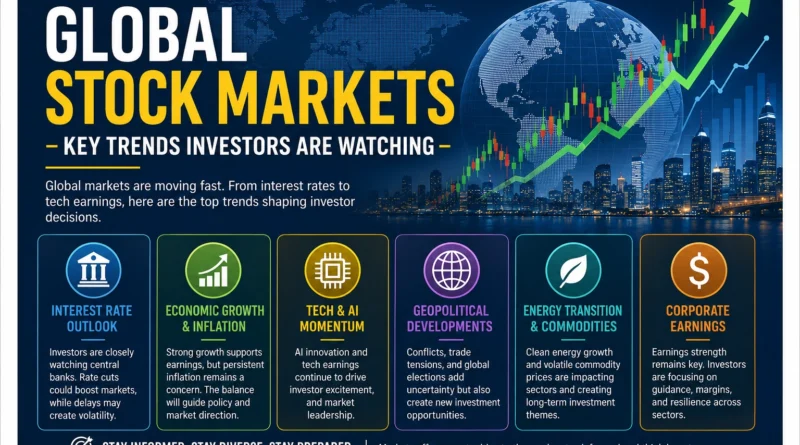
Global stock markets trends worldwide have posted one of the best first half performances in many years, but the results have not been consistent. The drivers of the movement — an AI investment craze, geopolitical events and interest rate sentiment — are conflicting across markets, with some hitting record highs and others languishing in double-digit declines. What are the trends on global stock markets now and what investors are looking on this year’s second half.
Key Takeaways
- Japan’s Nikkei 225 leads major global indexes with a 27.4% year-to-date gain, followed by Canada’s TSX (+10.2%) and the U.S. S&P 500 (+8.7%).
- The S&P 500 has just had the strongest quarter since 2020 and European stocks are at new record levels.
- Emerging global stock markets trends have been on the rise in the last six months, increasing by about 25%, particularly with South Korea’s nearly 90% increase.
- The BSE SENSEX index has fallen the most of all major indexes in India, with a year-to-date loss of 8.8%, while China’s Shanghai and Hang Seng indexes in Hong Kong are also in negative territory.
- While AI is the prevailing theme driving the rally, analysts are growing more vocal about identifying it as a source of concentration risk, alongside the returns it’s yielding.
- The renewed Middle East tensions and the current U.S.-Iranian conflict will likely be the biggest oil market wildcard and as such an inflation and interest rate policy wildcard.
AI is still the driver of all investments
There’s one story that’s supporting most of the big market events in this year, and that’s AI. Within the S&P 500, technology and communication services have been the top performers and strategists are pretty much unanimous that the AI-powered capital expenditure cycle is one of the key drivers of the global economy in 2026. Semiconductor shares in particular have had an outstanding year, and the Van Eck Semiconductor ETF is up about 70% over the past year. Concentration risk is the other side, which is growing more pressing for leading asset managers. The rally has been fuelled by strong bottom-up fundamentals and market breadth thus far, but many companies are calling the AI trade one of the biggest opportunities and dependency risks in the global stock markets trends in the lead-up to 2027, given the narrow group of market participants that have benefited from the rally so far.
It is not a valuation led bull market
Investors hoping to spot a bubble in global stock markets trends and are taking heart at one sign: The rally this year has been a result of new earnings, not stocks becoming more expensive in relation to earnings. For the second quarter, corporate earnings will move to a 20% growth, a pace that has been anticipated for both the quarter and for the second quarter in a row, market strategists note that almost all of the year-over-year returns for the S&P 500 come from the growth in earnings, not an expanding price-to-earnings ratio. That’s important because a global stock markets trends, that are going up thanks to real profit is normally considered more sustainable than one that’s going up just because of increasing prices.
The Emerging Markets have quietly taken over the show
Although the U.S. stock market has been all the rage on the AI side and boasting record levels, emerging markets have been the better performers over the last 6 months, gaining about a quarter. The standout has been South Korea, which is up nearly 90% from January. It’s a reminder that the biggest opportunities this year haven’t necessarily been where the most attention has gone.
The Rise of the Next Income Gap is the Wide Gap Between Winners and Losers
Not all the markets have been in the rally and the split has been large. Japan’s Nikkei 225 leads the pack with a year-to-date gain of +27.4%, Canada’s TSX at +10.2% and the US S&P 500 at +8.7%. The only indexes on a negative YTD basis are the UK’s FTSE 100 at -0.9% and the Euro Stoxx 50 at -1.6%. From the other side of the coin, the BSE SENSEX is the worst performer among the major indexes, sliding down 8.8% in the past year, whereas the Shanghai index in China (-1.9%) and the Hang Seng in Hong Kong (-4.3%) have also failed to gain momentum. Those investors with internationally diversified investments will find that spread a reminder that global markets are not the same regional and country-specific dynamics remain very significant.
The biggest wildcard continues to be geopolitics.
The markets globally have taken a lot of this year both political chaos in various countries, an ongoing US-Iran conflict in the Middle East and more volatility around oil. The current tension between the United States and Iran, and the potential effect it could have on the price of oil, remains a key oil price and inflation swing factor for analysts to watch. Several leading forecasts suggest a renewed uptick in oil prices, which would likely keep inflation elevated for longer, making it harder for central banks to start cutting interest rates — a development bond markets have been wary of amid a rally in equities.
The bottom line: What investors are watching
Here are a couple of threads that will likely set the tone for the second half of the year:
- The ability to sustain growth in earnings. The fact that so much of the rally has come on profit growth and not just on rising multiples may make a slowdown in earnings a quick turnaround for the market’s risk calculation.
- Oil and geo-political risk. The wildcard that threatens to mess with the otherwise quiet inflation picture, buoyed by the easy inflationary expectations, is the US-Iran conflict.
- AI concentration risk. With increasing amounts of capital flowing into fewer mega-cap, AI-driven businesses, several large asset managers are signalling that they are increasingly focused on diversification and risk management — and not just because of the influx of big IPOs.
- If the strength of emerging markets persists. Whether emerging markets and South Korea in particular can maintain their momentum after beating developed markets for six months will be a big test to watch.
A Note on Sourcing
The information and analysis included herein are based on recent coverage and outlooks of various market data sources, as of mid to late July 2026, provided by ETF Trends, Advisor Perspectives, Fidelity UK, Charles Schwab, Goldman Sachs Asset Management, Loomis Sayles, Russell Investments, and CNBC. Global stock Markets trends change rapidly and the information provided is subject to change; investors are advised to verify the prices and information on the markets at the time of investment. It is important to note that this article is for informational purposes only and is not financial advice and should be used only as such by a licensed financial advisor.
