
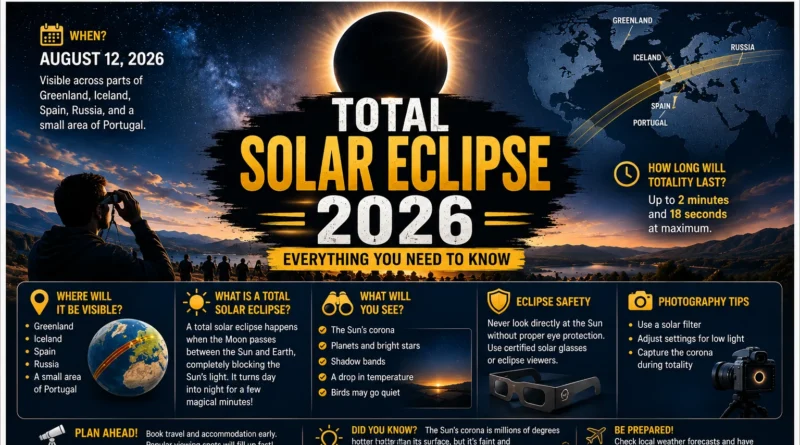
Total Solar Eclipse 2026 – Everything You Need to Know
Study Findings
- The Only Total Solar Eclipse of 2026 Happens Today, July 12, Over Remote Siberia, Greenland, Iceland, Northern Spain… and a Sliver of Portugal
- It’s the first total solar eclipse visible from mainland Europe since 1999, and the first one Spain has seen since 1905!
- Maximum eclipse will last up to 2 minutes and 18 seconds (and that’ll happen at 5:46 p.m. UTC)
- Most big cities in Europe like Madrid, London, and Paris will see a large partial eclipse (90%+), even outside the path of totality.
- NASA, CBS News , and timeanddate.com will have live streams for those not in the path of totality.
Total Solar Eclipse 2026: Everything You Need to Know
When and where the eclipse will be visible
Unlike most eclipses that are cast from west to east, this Total Solar Eclipse begins in an unusual place and direction. It rises over the Siberian Taymyr Peninsula at 11:59 PM local time, because the sun does not set there in summer. It peaks at 2:19 AM UTC, then curves south over the Arctic Ocean and pole, grazing Greenland at 1:30 PM ET, crossing Iceland at 1:45 PM ET. It ends over northern Spain, missing the cities of Madrid and Barcelona, ending at 2:45 PM ET. The maximum eclipse occurs at 5:46 PM UTC, while partial eclipse will be visible in Canada, the northern U.S., Europe, and northwest Africa.
How to safely watch the eclipse
Careful! You should never watch an eclipse with the naked eye except during the brief period of totality (when the moon completely blocks out the sun). Even partial eclipses can severely damage your eyesight if you aren’t using eclipse viewing glasses. You can make your own pinhole viewer to safely watch the eclipse indirectly. If you’re not in the path of totality or it’s cloudy where you’re located, you can check out NASA’s live stream, which is set to begin at 1:15 p.m. ET. Meanwhile, CBS News will have a live broadcast starting at 2:00 p.m. ET from Mallorca, Spain, where totality is expected to begin around 2:30 p.m. ET.
What makes this eclipse special
This Total Solar Eclipse is the first one visible from mainland Europe since 1999, and only the third time in history that a total eclipse has passed over Europe, in fact. It was last seen crossing the far western portion of the continent (Georgia, Russia) in 2006, and the northernmost tip (Faroe Islands and Svalbard) in 2015. For Spain, however, it’s a truly special event – the first total solar eclipse the country has seen since 1905. Due to the path this eclipse takes, sunsets will occur while the sun remains partially eclipsed for anyone along the westernmost edge of the path in mainland Europe and Africa.
Best places to see the eclipse and what to expect
Most eclipse tourists are likely to be in Iceland and Spain because these countries are estimated to have the highest number of people in the path of totality. The line of darkness will stretch from Spain’s northern coast through the Balearic Islands, missing Madrid and Barcelona, and reaching about 290 km. Northern Spain has a wide range of landscapes from mountains to coast, making it a great place for observing the eclipse. The Iberian Peninsula is also expected to be drier and cloudier than the Arctic Ocean and Greenland, according to meteorologists.
Science & research
- During totality, solar physicists will be able to get an unparalleled, close look at the sun’s corona, learning more about its structure, temperature, and how it contributes to the solar wind – information that isn’t possible to gather any other way due to the corona’s immense distance and difficulty to observe from afar.
- Since two-thirds of this eclipse’s path of totality falls over open ocean, researchers and the media should be especially mindful of the weather conditions for cloud cover over the Arctic and Atlantic oceans, since those will determine how much the eclipse can be seen from boats.
- Both NASA and the European Space Agency (ESA) are set to provide resources for scientists and the public alike to follow the eclipse. Observatories in Iceland and Spain will also team up to make synchronised measurements of the corona throughout the duration of the eclipse, taking advantage of the different time zones.
Where to find eclipse news and coverage
- Live weather and cloud cover updates for Iceland and northern Spain as the eclipse approaches.
- Live updates on the time of totality in popular destinations like Reykjavik (5:48 p.m. local time) and Mallorca, Spain (around 2:30 p.m. ET).
- The next total solar eclipse (which will be visible from Spain, Africa, and the Near East) is set to occur on August 2, 2027, and an annular eclipse (with a“ring of fire”) takes place on January 26, 2028, over South America, Portugal, and Spain.
Conclusion
Today’s Total Solar Eclipse is a special event, not only because it ends a 27-year long break between Europe’s last total eclipse and this one, but also because it is Spain’s first total eclipse since 1905. Whether you are seeing the full eclipse or just a partial one, as many people in London and Paris will be, you should enjoy this rare and impressive display. The next total eclipse occurs in August 2027, so be sure to see if the ‘shadow’ will cross Spain again. Remember to follow the Nexus of Nation for more scientific news.
FAQs
When is the next eclipse after this one?
The next total solar eclipse after this one will take place on August 2, 2027, and will be visible from Spain, northern Africa, and the Middle East.
Is it safe to watch an eclipse without glasses?
Only during totality (when the moon completely covers the sun), and even then, you have to be in the path of totality, too. Outside of that, you should always use eclipse viewing glasses or another method when watching a partial eclipse, or anytime you aren’t in the umbra (totality).
How long will the eclipse last?
At most, it’ll last up to 2 minutes and 18 seconds, but that’ll be only at the point of maximum eclipse along the centerline.
Will there be anywhere outside the path of totality that can still see the eclipse?
Yes! A much larger region, including most of Europe, Canada, and the northern part of the United States, will be able to see a significant partial eclipse (up to 90%+ in places like Madrid, London, or Paris).
Why does this particular eclipse take an odd path over the North Pole?
Most eclipses usually track generally from west to east, but this one will curve up and over the North Pole due to the orbital dynamics of the moon, making for an unusual path over the Arctic region preceding its passage over Europe.
