
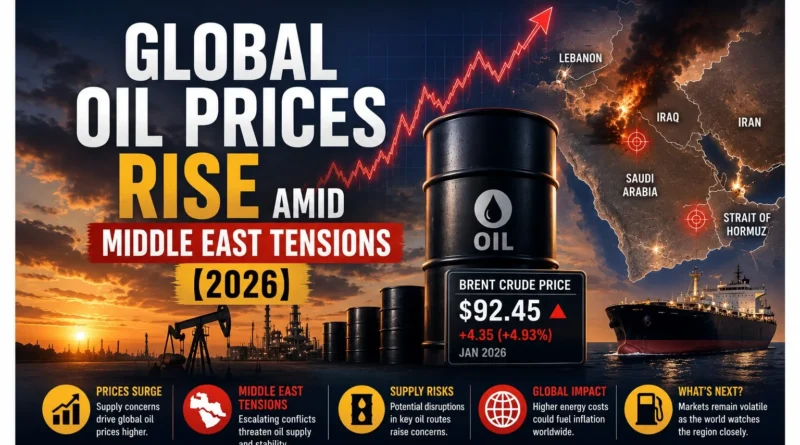
Global Oil Prices Rise Amid Middle East Tensions (2026)
Key Takeaways
- Global oil prices surge as Brent crude has climbed above $90 a barrel, its highest level in months, as renewed fighting between the United States and Iran threatens two of the Middle East’s most critical oil export routes.
- The escalation follows the collapse of a ceasefire reached in June, with US forces completing a ninth consecutive night of strikes against Iranian targets.
- The Strait of Hormuz, through which roughly a fifth of the world’s oil passes, has seen commercial traffic sharply curtailed, while Iran has reportedly told Houthi forces to prepare to disrupt Red Sea shipping as well.
- Global oil prices have swung dramatically over the past several months — falling below $71 in late June on hopes of a lasting truce, then rising more than 10% in a single week in mid-July as hostilities resumed.
- Analysts warn that if both key choke points are disrupted simultaneously, prices could climb well beyond current levels.
What’s Driving the Price Surge
The latest spike traces back to a fragile June ceasefire, when the US and Iran agreed to end hostilities and reopen the Strait of Hormuz, closed since late February — sending Brent down to around $70 by early July. The calm didn’t last. Fighting resumed in mid-July, with the US striking Iranian targets and Iran retaliating across Bahrain, Jordan, Kuwait, Oman, Qatar, and Syria. Iran has also reportedly told Houthi forces to prepare disrupting Red Sea shipping, raising the risk of both major oil routes being hit at once. This reflects real supply risk, not just speculation: tanker traffic through Hormuz remains sharply limited, and the US has reinstated a naval blockade near Iranian ports.
The Numbers
Brent crude rose about 2.5% on July 20 to top $90 a barrel, while WTI climbed to roughly $84. That’s a sharp swing from just three weeks earlier, when Brent had fallen below $71 on hopes the June ceasefire would hold — and prices jumped more than 10% in a single week in mid-July as conflict reignited. For comparison, the EIA’s most recent outlook, published just before this escalation, had forecast Brent averaging around $85 for 2026. Some bank forecasts see prices going considerably higher if Hormuz stays disrupted through summer — one estimate puts Brent as high as $110 on average for the year if normalisation slips into late August.
Countries Affecting the Most
- Iran — At the centre of the conflict, with its threats to the Strait of Hormuz and instructions to Houthi forces regarding the Red Sea route directly shaping market fears.
- United States — Has conducted repeated rounds of strikes against Iranian military and infrastructure targets, with President Trump also warning of further action against Iranian infrastructure.
- Gulf states (Bahrain, Jordan, Kuwait, Oman, Qatar) — Have been targeted in Iranian retaliatory strikes, raising the risk of wider regional spillover.
- Iraq — A notable exception to the disruption, with Iraqi crude loadings more than doubling in early July as exports accelerated despite the broader regional turmoil.
- Israel — A party to earlier rounds of the conflict, whose earlier ceasefire with Iran had briefly eased market fears before hostilities resumed.
Market & Economic Impact
Energy stocks have generally outperformed broader indices during the price swings, while airlines, shipping companies, and other oil-intensive industries face rising input costs amid the surge in global oil prices. The volatility has also complicated central banks’ inflation outlooks, since higher oil prices tend to feed directly into transportation and goods costs. The EIA’s latest analysis found that elevated fuel prices, shortages, and government efforts to curb consumption have already dampened global oil demand — helping limit inventory draw downs despite the region’s lost supply.
Impact on Consumers
Higher crude prices typically translate into higher prices at the pump within days to weeks, particularly in countries heavily dependent on imported oil. Beyond fuel costs directly, sustained price increases tend to ripple into the broader cost of living — higher shipping costs affect the price of imported goods, while airlines often pass higher fuel costs on through ticket prices. Oil-exporting nations, by contrast, generally benefit from higher prices through increased export revenue.
Historical Context
This isn’t the first time Middle East tensions have driven sharp swings in global oil prices, but the current volatility has been unusually extreme even by historical standards — with prices falling from over $95 a barrel in earlier months of the conflict to below $71 in late June, only to surge back above $90 within weeks. That kind of rapid reversal reflects just how sensitive global oil prices remain to developments around the Strait of Hormuz specifically, given its out sized role in global oil transit.
What Comes Next
Much depends on whether the current round of hostilities can be de-escalated as the June ceasefire briefly achieved. Analysts are watching closely for signs of renewed diplomatic engagement, further attacks on oil infrastructure or tankers, and whether the Bab el-Mandeb route joins the Strait of Hormuz as a second major choke point under threat. Bank forecasts vary widely depending on how long the disruption persists, underscoring how much uncertainty remains baked into current prices.
A Note on Sourcing
Oil markets move quickly, and figures in this post reflect trading levels and forecasts as of July 20, 2026, drawn from market data providers, the U.S. Energy Information Administration, and financial news outlets including Reuters and CNBC. Prices may have shifted further by the time you’re reading this. For continued coverage of global markets and geopolitics, visit Nexus of Nation.

Pingback: The Global Economy in 2026 - Key Trends to Watch - Nexus of Nation