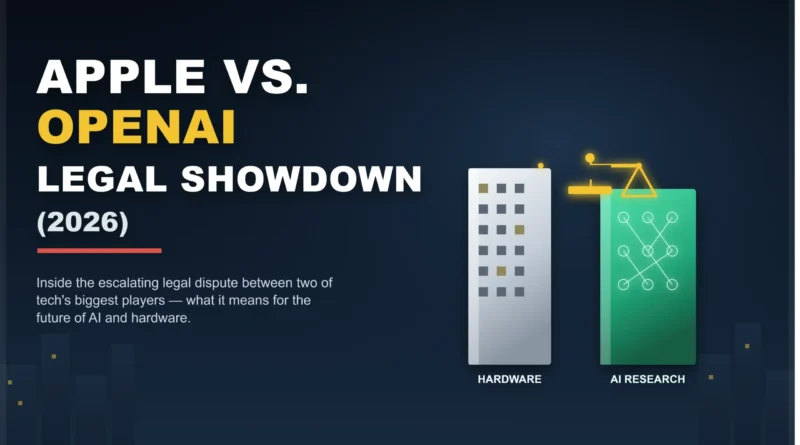
Apple vs. OpenAI: Inside the Legal Showdown (2026)
Key Takeaways
- Apple vs OpenAI both are involved in a legal conflict stemming from accusations that the AI company exploited confidential information on hardware designs and manufacturing processes for unreleased consumer products, as well as suppliers.
- Apple filed a 41-page lawsuit with the United States District Court for the Northern District of California on July 10, 2026. It names ex-Apple executive Tang Tan, the newly hired OpenAI Chief Hardware Officer, and ex-Apple executive Chang Liu as defendants, alongside OpenAI and related hardware development company io Products.
- Meanwhile, Apple has already sent legal preservation notices to roughly 40 ex-Apple employees working at OpenAI out of more than 400 total, according to reports. In turn, OpenAI has strongly denied the accusations, asserting that “we have no interest in other companies’ trade secrets” and that “we believe in fair competition.”
- This dispute is the latest in a series of high-profile legal issues involving OpenAI, coming two months after a closely-watched Elon Musk vs. OpenAI trial ended in a victory for the latter. The case comes as OpenAI looks to go public with what promises to be a landmark IPO.
What Apple Is Accusing OpenAI Of
Apple’s complaint revolves around allegations targeting OpenAI for receiving and utilising trade secrets belonging to Apple that were obtained by ex-Apple employees, with the company claiming that such acts occurred “at all levels, ranging from members of its Technical Staff to its Chief Hardware Officer.” Some of the accusations detailed in the lawsuit are highly specific. Apple asserts that OpenAI “contacted one of our suppliers using confidential information about power and battery technologies,” going as far as citing internal jargon in regards to certain components. In addition, Apple alleges that io Products “convinced one of our manufacturing partners that it was permitted to use a confidential metal finishing process.”
Who The Accusers Are
Apple initiates a lawsuit against OpenAI for alleged intellectual property theft by several key employees who left Apple and joined OpenAI and shared with them confidential information on products that the company is working on. The two employees named in the suit include Tang Tan and Chang Liu. Tang Tan was Senior VP of Product Design at Apple, where he designed the iPhone and the Apple watch. He left Apple in Feb this year to work for Jony Ive forming his design company which he then becomes the Chief Hardware Officer of at Open AI.
What Triggered The Fall-Out
The fall-out between Apple and OpenAI stems from multiple former Apple employees allegedly joining the AI company and providing it with access to internal information and suppliers as it develops its own hardware products. The issue originated from OpenAI hiring several members of Apple’s hardware design team ahead of the formation of its own hardware division, with Tang Tan and Jony Ive at the vanguard of the efforts. Apple attempted to discuss the accusations with OpenAI before eventually bringing the issue to court, with the company claiming in the lawsuit that it had “no choice” but to do so and that “attempts to informally resolve the dispute have proven unsuccessful.”
Apple’s Latest Steps Following The Lawsuit
Apple has undertaken several measures to investigate the allegations in the lawsuit. In particular, Apple took legal action against about 40 former Apple employees at OpenAI after initiating the case. The service providers received preservation letters demanding that they preserve any information and documents that can be used as evidence of trade secrets theft. Notably, the letters do not confirm that Apple has discovered evidence. Instead, the messages show that Apple believes the evidence of intellectual property (IP) infringement “may exist beyond those specifically identified in the complaint.”
OpenAI’s Response To The Lawsuit
Several days after Apple filed its lawsuit against OpenAI, the defendant released an official response. “We believe in fair competition and allowing people the freedom to work wherever they choose, and we’re focused on our mission to bring innovative technology to empower people around the world,” OpenAI wrote in a statement. Its initial response to the allegations, released hours after the lawsuit was filed, was far less detailed and simply stated, “We have no interest in other companies’ trade secrets.”
What The Conflict Means
Besides the issue of industrial spionage, the OpenAI vs. Apple conflict poses another problem, namely, the OpenAI’s devices development possibility for the time being. Analysts suppose that the OpenAI’s product design is at risk of being cancelled before the trial’s outcome due to litigation expenses, which have already become excessively high. Moreover, poor timing is also a severe issue as OpenAI is preparing to go public. The lawsuit lists several accusations, yet, Apple did not comment on whether this dispute impacts their collaboration with OpenAI. The relationship between the companies is mutually beneficial as Apple integrates ChatGPT to its Apple Intelligence, while OpenAI receives a significant distribution channel for its products.
Open AI vs. Apple Conflict Resolution Essay
The OpenAI vs. Apple conflict resolution takes place as the company faces a series of lawsuits and issues. In particular, one of the OpenAI co-founders, Elon Musk, accused the company of reneging on its promise to remain a nonprofit, and a federal jury ruled in Musk’s favour in a closely watched trial last month, after two months of deliberations. Nevertheless, although Musk is prepared to appeal the decision, he was found to have acted too late in initiating the case. Meanwhile, OpenAI is witnessing an unprecedented talent theft as several technology companies are trying to recruit the organisation’s personnel, including its chief executive officers, and other essential experts.
What To Expect Next
Much remains unknown about the OpenAI vs. Apple dispute, but with Apple sending out legal preservation notices to numerous ex-Apple employees at OpenAI, there is a possibility that more individuals accused of violating trade secret laws will be added to the lawsuit, not to mention more evidence being presented in court. For now, the central question surrounding this conflict involves how this dispute will affect OpenAI’s plans to develop hardware, as the litigation could derail OpenAI’s road map for the time being. In addition, the OpenAI vs. Apple conflict could serve as a precedent for future disputes, with Apple’s specific accusations potentially influencing other ongoing cases.
A Final Note
This article covers an ongoing legal conflict, and new developments have the potential to arise frequently. Information detailed in this article comes from various reports, including pieces published by Bloomberg, TechCrunch, CNBC, and 9to5Mac, with Apple filing the lawsuit as of July 10, 2026. Please note that this article only summarises the information provided by these outlets, many of which contain more detail. In addition, please remember that a lawsuit is not an admission of guilt, nor is a court’s ruling meant to be considered an official judgement. For other news pieces, visit Nexus of Nation.
