
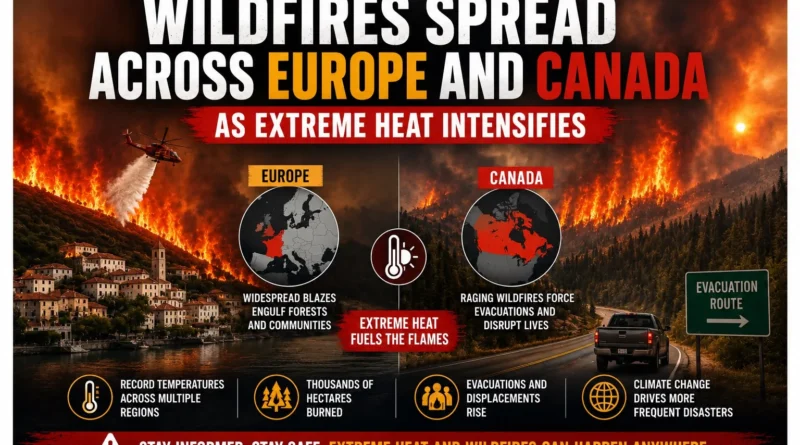
Wildfires Spread Across Europe and Canada Amid Extreme Heat (2026)
Key Takeaways
- Wildfires spread across Europe and Canada, where the United States has burned roughly 110 square kilometres so far this year, nearly twice the rate of 2025, while Western Europe is set to experience its third heat wave of the summer
- Canada’s 2026 wildfire season got off to a slow start but has since seen a significant uptick in the number of wildfires burning across the country, with the most recent conflagrations erupting in northern Minnesota and western Ontario in mid-July.
- Thunder Bay, Ontario, experienced temperatures as high as 39.5 degrees Celsius, breaking the city’s record by more than two degrees, while nearby Armstrong, Ontario tied the hottest temperature ever recorded in the province.
- Massive amounts of wildfire smoke have led to an historic air quality crisis throughout much of the US. Great Lakes and Northeast regions, with air pollution experts saying the smog may well be worse than the near-record smoke of June 2023
- Meanwhile, Europe’s electricity grid is being stressed due to record-breaking heat, with France’s EDF warning that it may have to restrict electricity production at several nuclear facilities due to the inability to cool reactors with the lower water levels of the rivers used for that purpose
Europe’s Wildfire Crisis
Europe is expecting another heatwave this summer. Many countries, including France, have already had wildfires in 2025, June, declares the French Minister of the Interior, Laurent Nuñez, about 110 square kilometres, about half of the 2025 total, have already burned in France this year. The countries most at risk from the impending heatwave are Portugal, Spain, France, Italy, Greece, the Balkans, Turkey, Cyprus, Germany, Poland, and the Alps. Southern Greece, Thessaloniki was forced to close down due to fires this July, following the hottest summer in 2025 to date. Over 2,000,000 hectares burned and more than 30 people died during 2025. Authorities say that it is not just the heat that contributes to wildfires but a combination of factors, so it is the worst case in several countries this summer.
Canada’s Wildfire Surge
Unlike in the previous years, Canada’s 2026 wildfire season got off to a relatively slow start. However, that did not stop major wildfires from erupting in northern Minnesota and western Ontario on July 13, 2026, threatening numerous communities. The heat wave that caused the conflagrations raged through the region, with Thunder Bay recording the highest temperature of 39.5 °C, breaking the city’s previous record by more than 2 °C. The heat wave also triggered unprecedented wildfires that caused at least two of the pyrocumulus clouds to form in Ontario – the type of cloud usually found in the stratosphere. High winds and the dry weather, resulting from the spruce budworm infestation and the 1999 derecho, added to the intensity of the already severe blazes.
The Smoke Crisis Across North America
Wildfires that have ravaged Canada have led to severe smog and air pollution challenges beyond the regions they are currently burning. The thick plumes of smoke from the conflagrations in Ontario and Minnesota had begun spreading east from July 15, causing grey and orange skies and days of smog in the eastern U.S. The air has turned out to be extremely polluted as fifty (50) air quality monitoring stations in five (5) states were recording the “Hazardous” category on July 16, including nine (9) in Ontario. Experts on air pollution have linked the unprecedented volume of particulate matter to the near-record-breaking smoke of June.
Strain on Infrastructure
The extreme heat is also impacting the electrical grid in Europe, as French electricity prices surged to record highs and the threat of wildfires grows. EDF (Électricité de France) warned that it could have to partially shut down its Chooz nuclear power plant because the cooling river there, the Meuse, has low water levels. Authorities in France warned of impacts to other nuclear plants, including Blayais, Bugey, Golfech, and Saint-Alban, after a warming of the rivers Garonne and Rhône.
The Climate Change Connection
It is worth noting that the significant heat that has caused the wildfires across Europe has already been linked to climate change, with scientists noting that without human involvement, the record-breaking heat would have been highly unlikely. This conclusion comes from the Climate Shift Index at Climate Central, which highlights the particularity of the heat that fuelled the Canadian wildfires. Similarly, the unprecedented heat of 2025 experienced across Europe has also been connected to climate change, which has exacerbated the wildfires that ravaged the region, with many scientists warning that such events would become normal as the planet continues to warm.
Government & Emergency Response
The Canadian government believes that the risk of wildfires will increase during the summer, despite a relatively quiet start. The country has a decentralised system of emergency management, with the federal government, the military, and volunteers from the private sector, including teams like Team Rubicon, playing a role when local resources are overwhelmed. The government has noted the disproportionate impact of the wildfires on Canada’s First Nations, who have been evacuated, leaving many Elders without the support they need and causing social isolation for children. Meanwhile, in Europe, governments are cooperating to deal with large wildfires, such as using each other’s Canadair planes during the 2025 fire season.
Travel & Public Safety Advisories
The number of wildfires and the extreme heatwave that has pushed temperatures across Europe above 40 degrees Celsius has resulted in the Government of Canada updating its travel advisories for France, Spain, Italy, Germany, and the UK, warning that visitors should be extra cautious given the extreme temperatures, along with the expanding wildfires and public safety concerns. Given the current climate and the peak travel season, these warnings could have repercussions for the tourism industry, particularly as visitor numbers are at their highest during the summer.
What Comes Next
Authorities are predicting the combination of wildfires and extreme heat to linger throughout much of Europe for the rest of the month, with the accumulated heat lying behind the dangerous conditions rather than a heatwave in itself. At the same time, Canadian officials are remaining on high alert as the Canadian Wildland Fire Information System suggests that the danger of wildfires is likely to increase through the rest of the summer despite the slow start to the season.
A Note on Sourcing
This is a developing situation affecting multiple regions. The information contained in this post was collected from multiple news outlets, including Bloomberg/Insurance Journal, Yale Climate Connections, EarthSky, Pogodnik. com’s weather forecasts, and the Government of Canada’s 2026 wildfire season website, as of July 21, 2026. Conditions may change rapidly as the situation evolves, and this post will be updated as new information becomes available. To stay up to date on global affairs, visit Nexus of Nation.
