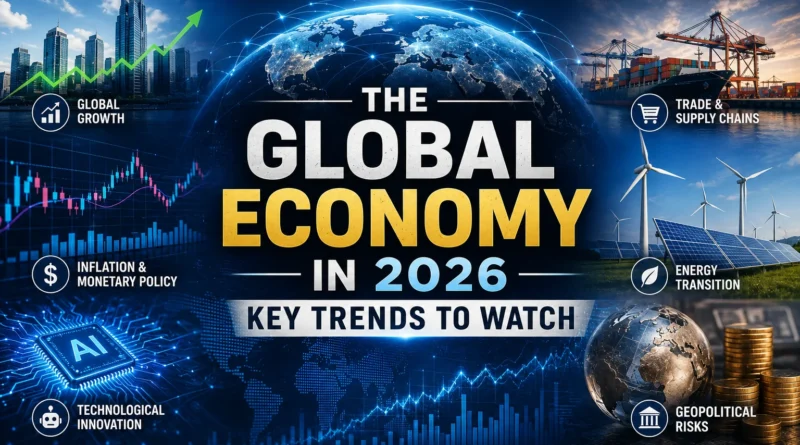
The Global Economy in 2026 – Key Trends to Watch
Key Takeaways
- The global economy is set to grow by 3.0% in 2026, according to the IMF, down from a 3.3% growth forecast previously, due to the economic shock from the war that began in the Middle East in February.
- The growth is projected to recover slightly to 3.4% in 2027, if the war does not escalate significantly and for longer than expected
- Investment in AI technology is set to offset some of the trade and geopolitical headwinds, benefiting countries integrated in the global technology value chain, primarily in North America and Asia
- Global disinflation, which had steadily declined since 2023, has stalled, according to the IMF, with the war fuelling higher inflation than initially forecast
- While the Fed is poised to cut rates modestly through 2025, the ECB is set to cut more aggressively, while Japan raises rates as it unwinds three decades of ultra-loose monetary policy
The Headline Number: Global Growth in 2026
The IMF’s July 2026 World Economic Outlook titled “Global Economy in Crosscurrents of War and Technology”, which was released this week, forecasts global growth of 3.0% in 2026 and 3.4% in 2027, roughly in line with the April 2026 projections. That is a significant downward revision from where the IMF was at the beginning of this year: as recently as January 2026, with the war yet to erupt, the IMF still anticipated a 3.3% growth for the global economy in 2026, with the Fund’s Chief Economist Pierre-Olivier Gourinchas even suggesting that “the global economy was on a path of steady growth” that the Fund was set to upgrade
The Middle East War’s Economic Shockwave
The Middle East conflict that erupted at the end of February and complicated the situation for the global economy has impacted the prospects for growth, according to the IMF. “The war has put on the brakes to the trend,” said Gourinchas, noting a 3.1% increase and 4.4% inflation in the period, which is significantly different from the previous trends. The IMF experts highlight three main areas of impact: growing energy and food prices, persistent wage-price spiral, and a confidence shock. The effect was not even across countries: the forecasts for April 2026 suggest visible divergences, with the strongest headwinds for emerging and developing economies, as well as nations dependent on imported energy, and the region directly affected by the conflict.
Must Read: Global Oil Prices Rise Amid Middle East Tensions (2026)
AI Investment as a Counterweight
Meanwhile, one factor has acted as a counterweight to the war’s impact on the global economy: technology investment. The latest IMF update suggests that demand driven by artificial intelligence is set to benefit countries integrated in the global technology value chain, with North America and Asia seeing the most gains. Earlier this year, before the war, the IMF had already noted that investment in technology was accelerating, with capital expenditures on AI being a significant growth driver that offset trade policy headwinds. At the same time, the IMF highlighted that the “reassessment of technology expectations” – a scenario where AI-driven productivity gains fail to materialise – would be a significant downside risk to the global economy, alongside the war and geopolitical tensions.
For You: Apple vs. OpenAI
Inflation: Stalled, Not Solved
Global disinflation, which has steadily declined since 2023, appears to have stalled, according to the IMF. With the war impacting the global economy, inflation in 2026 is set to be higher than the Fund had initially expected. The latest projection suggests that inflation will peak at 4.4% – up from the 4.1% the IMF had anticipated for 2025, with inflation expected to ease to 3.8% in 2026 and 3.4% in 2027. Meanwhile, the Eurozone’s inflation is set to be “around the ECB’s 2% target,” converging towards it in 2027, with China’s inflation rising from near-zero levels and India’s inflation, after dipping below the target in 2025 due to lower food prices, expected to return to it.
Central Banks Moving in Different Directions
Central banks are diverging: the Federal Reserve is poised to cut rates moderately through 2025 to meet its 2% inflation target and bolster employment, while the European Central Bank is set to tighten more aggressively after economic growth projections for the Eurozone have been downwardly revised and disinflation has accelerated. The Bank of Japan remains the lone G7 central bank that is set to raise interest rates in 2026 as it unwinds three decades of easing policy; the policy rate is projected to rise from 0.5% toward a neutral rate of around 1%.
Advanced vs. Emerging Economies: An Uneven Recovery
- Advanced Economies – 1.8% growth
Factors: easing labour markets, weaker sectors (steel, aluminium, lumber, finished autos) exposed to trade tensions, and rising unemployment through 2025 - Selected Emerging Markets – Outperformers
Factors: domestic reforms - Broader Emerging-Market Group – More vulnerable to the downturn
Factors: greater sensitivity to the war’s effects on inflation and growth
Key Risks on the Horizon
The IMF’s own assessment of risks to growth includes a longer or broader war than expected, geopolitical fragmentation, reassessment of AI-driven productivity, and renewed trade tensions, among others. Additionally, rising public debt and credibility concerns in a number of economies add to the risks, with the Fund noting that downside risks to growth remain “overall tilted to the downside,” even if some had been “partially offset” since April 2026.
What This Means Going Forward
If 2026 has a single overarching theme for the global economy, it is divergences. Tighter monetary policy in advanced economies dampers growth as central banks grapple with the dual mandate of curbing inflation while supporting employment, and a depreciating renminbi and capital flight from China complicate matters as it seeks to mend its accounts. Elsewhere, the impact of the war on energy-importing economies is being partially offset by investment in AI, an area in which they have significant exposure. The ability to meet the 3.4% GDP growth forecast by the IMF for 2027 will depend on de-escalation in the Middle East and the extent to which investment in AI will be transformative for productivity.
Sources
Global economic forecasts are subject to frequent revisions, and this post reflects the latest projections from the IMF’s World Economic Outlook as of July 2026, alongside Deloitte’s 2026 Global Economic Outlook. As such, it captures a specific moment in time rather than a definitive forecast, as economic conditions are rapidly evolving – as evidenced by the change in the IMF’s growth forecasts for 2026, which were downwardly revised several times this year. In the future, as more information becomes available, these forecasts may be updated again in subsequent editions of the IMF’s World Economic Outlook. For more analysis on global economic outlooks and markets, return to Nexus of Nation.
