Iran Warns – Strait of Hormuz “Never” Returning to Normal
Key Takeaways
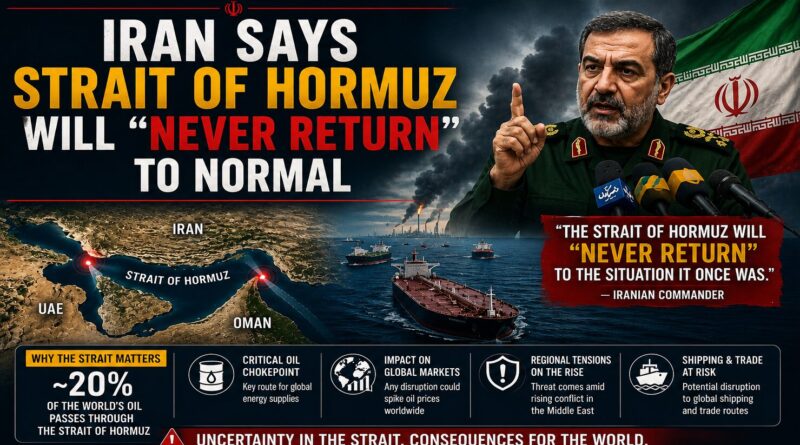
- Iranian authorities have made numerous statements about the Strait of Hormuz never being the same again, including armed forces’ spokesman Ebrahim Zolfaghari’s assertion on July 22 that the Strait of Hormuz will never go back to its pre-war status.
- Iran’s top negotiator, Parliament Speaker Mohammad Bagher Qalibaf, has stated that Iran will take the control of the strait going forward “in accordance with international law,” and not the status quo that preceded the war.
- Abbas Araghchi, the foreign minister, said that if a final agreement is reached between the US and Iran, the waterway will have a completely new framework, including new shipping service charges.
- The strait has been reopened de facto in a negotiating period of 60 days under a memorandum of understanding agreed on in June, but the agreement has been strained by renewed fighting.
- The U.S. attacks on Iranian targets restarted in mid-July following the failure of the ceasefire agreement in June, adding another layer of uncertainty to any potential long-term deal for the strait.
What Iranian Officials Are Saying
The idea that the Strait of Hormuz will never be the same as it was before the war has been a recurring theme since Iran’s government in 2026. Most recently, an official from the armed forces Ebrahim Zolfaghari stated it was “not what it was before the 40-day war”, alleging the US was destabilising the waterway. This is a repeat of June comments by Qalibaf, Iran’s parliament speaker and lead negotiator, who said the strait’s administration “will never come back to the past before the war”, but “international regulations will be observed. Foreign Minister Araghchi also stated it could be done under a new framework – perhaps with new shipping rates – once a wider framework is reached.
Why This Matters: The importance of the Strait at the global level
One of the Asia’s most important shipping choke points, the Strait of Hormuz transports a significant portion of global oil and energy supplies from the Persian Gulf oil producers to the rest of the world. It was used for commercial traffic, which was severely cut following fighting in the region in late February that affected a key route for global energy markets. Transit activity has resumed since the signing of the US-Iran memorandum of understanding, but both sides remain cautious about the situation being the outcome of a “return to normal.
Never Return to Pre-War Conditions – What Does This Mean?
In reality, Iranian officials appear to be referring to changing the control of the strait rather than just damage. Transit will be free for at least 60 days, according to the June memorandum, while the US and Iran work out a larger deal, but experts believe the terms could be different than pre-war. “This is not the old strait of Hormuz dynamic that existed prior to the war, we are in a new one now, Noam Raydan, senior fellow at the Washington Institute, told CBS News. Iran has established this new navigational order and Iran’s job at the moment is to make sure it’s central to it,” said this new navigational order.
The wider conflict context.
Iran’s warnings on the Strait of Hormuz are not coming out of nowhere — they’ve been accompanied by renewed violence that jeopardizes the ceasefire agreement. US Central Command has attacked Iranian military targets as recently as July 21, and Trump has threatened more attacks on Iranian infrastructure if they hit shipping facilities. At the ASEAN Summit, Rubio said the US was ready to continue negotiating with Asian leaders, but would impose “consequences” if Tehran “continues to breach its commitments. Meanwhile, Iran, which has been under a US naval blockade since April, says it has a sticking point for any last-round deal: the lifting of the blockade on its ports.
Possible New Shipping Arrangements
- Iran may be in the process of making a formal arrangement to impose new shipping service fees on vessels using the strait, Araghchi said in his remarks.
- The idea is comparable to that of the Suez and Panama canals: The idea is akin to that of the Suez and Panama canals:
- There is an important distinction, experts say: an explicit treaty permission for the charging of tolls for those canals, while the other ones were dug by man.
- There are international agreements that ensure free navigation through Suez and Panama for any vessel.
- This was a natural choke point in contrast to the Strait of Hormuz.
- Any new toll or administrative rule imposed by Iran would bring up other legal and diplomatic issues than those set by Suez or Panama.
Foreign and local responses
Developments in the strait are closely being watched by the shipping and energy sectors, as the waterway is vital to oil shipping. The new strikes and Iran’s repeated promise to forever alter the strait’s status have thrown more uncertainty on both the tanker operators and energy markets, despite a rise in transit volumes since the June memorandum was signed. In recent weeks, fighting has also spread into the territory of the Gulf states that border the strait, which have also been faced with increased security pressure.
What Comes Next
- The 60-day negotiating window from the June memorandum remains active, so whether the US and Iran can turn that into a solid deal in the face of renewed fighting will determine whether anything will come of it.
- Iran’s stated objective of administration of the strait is another important topic to consider: will it be brought into a final deal in a formal fashion?
- The other is if they are actually introducing new shipping charges.
- A third is if the ceasefire lasts long enough to get to the negotiating table and reach a resolution.
A Note on Sourcing
The report is multi-source with statements from various Iranian officials in multiple months and moving at a rapid pace. Information in this post is based on reporting from CBS News, Middle East Eye, Iran International, Press TV, Fox News and Marine Insight as of July 23, 2026. Due to the ongoing conflict and fluid situation, this information can be subject to change as negotiations and fighting continues. To see more news coverage of international conflict and politics, check out Nexus of Nation.
