
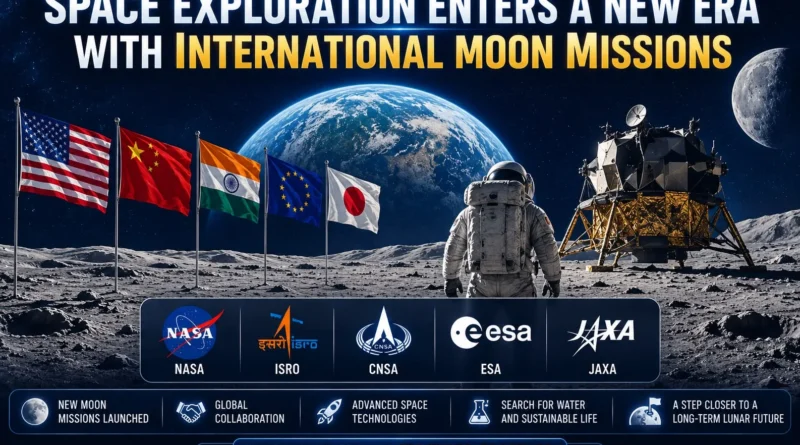
Space Exploration Enters a New Era with International Moon Missions
Key Takeaways
- Now space exploration enters a new era, the Moon has become the most active exploration venue in the solar system with NASA, China, India, Japan and several companies operating active lunar programs in 2026.
- Artemis II was scheduled to orbit the Moon in April 2026, the first crewed mission since Apollo 17 in 1972 to go beyond low Earth orbit, but Artemis III has been changed and now will be a docking test and Artemis IV is now planned for 2028 as the first crewed landing.
- Chang’e-7 will be launched to the lunar south pole in August 2026 with international experiments from Switzerland, Italy, South Korea, and other nations.
- Building on the successful Chandrayaan-3, India is planning a sample-return mission, Chandrayaan-4, which will be launched in 2027-28 and will be aimed at the south-pole of the moon.
- Commercial landers are now also a significant piece of the puzzle, with companies such as Blue Origin, Intuitive Machines, Astrobotic, and Firefly Aerospace operating missions through NASA’s Commercial Lunar Payload Services (CLPS) mission.
Why The Moon Again?
The Moon is now the most contested region in space exploration enters a new era after the Apollo and Luna missions, which have been dormant for decades. The Moon has been a quiet place after the Apollo and Soviet Luna programs, and has become the most contested in space exploration. Much of the interest in the renewed interest is in the lunar south pole, where deep craters which have not seen sunlight in billions of years are so cold that they can trap water ice. That ice could be used for future astronauts right where it is, or the ice could be split into drinking water, breathable oxygen, and rocket fuel, making the Moon an ideal staging ground for deeper exploration, even ultimately to Mars.
Who’s Racing to the Moon?
- The new Moon race is not only more diverse than any lunar race ever before, but more diverse than any spaceflight race ever.
- Operating Artemis, and the Commercial Lunar Payload Services program which has business partners to build robotic landers.
- China (CNSA) — Chang’e has already made the first landing on the Moon’s far side, the first robotic sample return since the 1970’s and the first samples from the far side. China is now seeking to take the next step and develop its International Lunar Research Station.
- India (ISRO) — After its historic landing on the south-pole of the Moon in 2023, India is developing Chandrayaan-4 as a sample-return craft, coupled with plans to get its crewed spaceflight ambitions into orbit with the Gaganyaan program.
- Japan (JAXA) — Japan is aiming for crewed landing in the 2030’s, and has already shown that it can land a robot with precision in 2024.
- There are commercial firms with lunar landers (some of them are under NASA contracts) that are flying or constructing these landers, such as Blue Origin, Intuitive Machines, Astrobotic, Firefly Aerospace, and SpaceX.
Recent & Upcoming Missions
2026 promises to be a bumper year of lunar exploration:
- NASA astronauts Reid Wiseman, Victor Glover and Christina Koch, and Canadian Space Agency astronaut Jeremy Hansen were four astronauts on board Artemis II on a approximately 10-day journey around the Moon where they tested life support, navigation and communications systems, in preparation for future lunar landings.
- Chang’e-7 is set to launch to the lunar south pole in August 2026, which is the same region that NASA and ISRO are interested in.
- NASA’s Commercial Lunar Payload Services (CLPS) missions, such as Blue Origin’s Blue Moon Mark 1, Intuitive Machines’ IM-3, Astrobotic’s Griffin-1, and Firefly Aerospace’s Blue Ghost Mission 2, are helping to fill 2026 with dozens of science and surface mobility missions to the moon.
- Chandrayaan-4 continues to be under development, with ISRO planning to attempt the first lunar sample return by India sometime in 2027–2028.
Working collaboratively with others versus working competitively with others
The present lunar race is peculiar in combining cooperation with competition in a manner not seen in the previous races in space. The Artemis Accords, a set of principles for coordination of exploration and resource utilisation, have been signed by over 30 countries. Meanwhile, China’s Chang’e-7 mission is carrying payloads from other countries, including Switzerland, Thailand, Italy, Russia and South Korea, as it is clear that, despite the current restrictions on direct US-China space cooperation in US law, multi-national science cooperation is a practical solution that works and can benefit all parties. But behind the partnership lies a true race: Who will be the first to put astronauts back on the lunar surface in this new golden age—whether it will be NASA or China is an open question, and both have experienced delays, budget overruns and political pressures.
Technology & Innovation Spotlight
The new generation of lunar missions relies heavily on new abilities that did not exist during the Apollo era such as precision landing systems (used by Japan’s SLIM mission, which landed within a few meters of its intended target), the ability to use reusable launch vehicles to reduce launch costs, and landers capable of functioning in the cold temperatures of permanently shadowed polar craters. Much of this technology is specifically targeted for the establishment of infrastructure for long-term missions which include landers, rovers and eventually habitats.
Challenges & Risks
At the present technology level, lunar missions are still challenging. In 2023, Russia’s Luna-25 probe crashed on an attempt to land and several commercial landing attempts in recent years have experienced partial or full failure. Budget overspending and delays are not uncommon, either: NASA’s Artemis III has since been changed to an orbital docking test, with the first crewed landing pegged for Artemis IV in 2028. In addition to the technical challenges, there are also governance and resource issues that are still to be fully resolved as more countries and companies aim to be active on the surface.
What will happen in the future?
It is notable that, in 2026, missions are no longer explored one-off events, but rather the beginning of a trend towards exploration as infrastructure building: landers, rovers, sample return missions, and eventually habitats to support a continuous human presence. The Moon is poised to become truly permanently inhabited for the first time since the end of the Apollo era in 1972, whether it’s NASA’s mission to the Moon under the Artemis program, or China’s International Lunar Research Station.
A Note on Sourcing
Mission timelines for the moon are subject to much change as technical, budgetary and political considerations play a factor. The dates and mission details in this post are the latest, public planning targets from NASA, CNSA, ISRO, and JAXA as of mid-2026 and are not guarantees. Follow Nexus of Nation for more news on the world’s space developments.