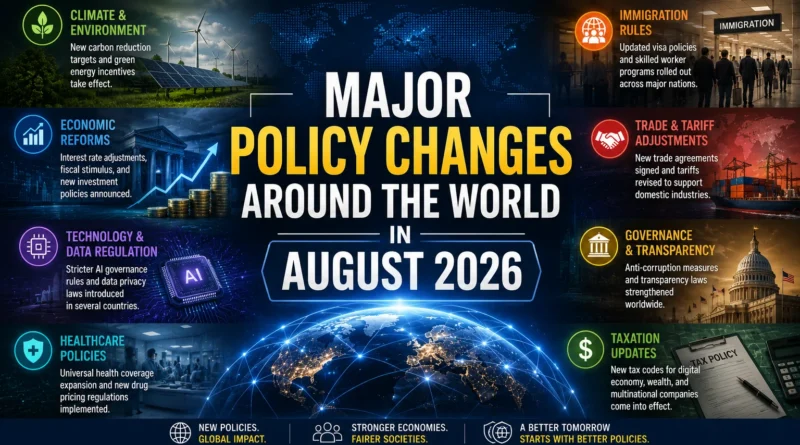
Major Policy Changes Around the World in August 2026
Study Findings
- Major policy changes are set to take place worldwide this August, starting with a new round of US tariffs under Section 338 on Canadian imports of everything from cement to hockey sticks to wine, effective August 19;
- India sees a number of everyday rule changes this year, including revised railway Tatkal booking process, income tax filing penalties, C-KYC 2.0, banking updates, and lower commercial LPG prices;
- The UK’s Immigration Rules and New Zealand’s Skilled Migrant Category changes begin on August 3 and 24 respectively;
- Hong Kong’s Stable coin Bill regime joins a growing list of global stable-coin regulations this year;
- Analysts note that 2026 is set to be a year when the effects of trade, immigration, and finance policy shifts made in 2025 begin to crystallise;
Trade & Tariffs
Major policy changes this August take the longest lead – President Trump’s new Section 338 tariffs of 50% on a broad range of Canadian imports, from cement and hockey sticks to wine, become effective August 19. They apply to all goods except for energy, potash, Section 232 goods, critical minerals, and fish, and even those subject to USMCA. This follows a busy summer for tariffs, as President Trump also imposed a separate 25% Section 301 tariff on Brazil, effective July 22. Analysts note that 2026 is likely to see the long-awaited culmination of a major shift toward protectionist trade policy, with significant effects on prices and markets already seen this year, and investment and consumption to follow in 2026.
India: A Wave of Everyday Rule Changes
India began the month of August with some significant regulatory changes that impact several areas of the daily lives of many Indians. From August 1, changes include:
- Tatkal booking changes: New rules for railway ticket booking for trains through Tatkal reservation scheme
- Income tax filing penalties: Changes to income tax rules related to the penalty for late ITR (income tax return)
- C-KYC 2.0: The upgrade to India’s consolidated Know Your Customer system
- Banking sector changes: Some adjustments to banking sector regulations,
- Commercial LPG rates cut: decrease in commercial liquefied petroleum gas prices.
All these changes affect a significant part of the Indian population – from personal income tax to traveling by train and expenses on cooking gas.
Immigration & Visa Changes
Several immigration-related major policy changes are due this August, including changes to the UK’s Immigration Rules effective August 3 and New Zealand’s Skilled Migrant Category changes arriving August 24. The former includes a change permitting a child born in the UK to a parent holding Graduate route permission to be treated as a dependant. The UK will also introduce a new Diplomatic Visa Arrangement for Indian diplomatic passport holders. Meanwhile, the New Zealand changes include the introduction of Skilled Trade and Technician Residency visas and revised qualification requirements, as well as simplified wage rules, affecting a range of Work to Residence visa categories, including Care, Transport, and Workforce.
Digital Assets & Stablecoin Regulation
Further Major policy changes in financial markets are also set to arrive this August, with Hong Kong’s Stable coin Bill – part of a wider global stable-coin regulation drive across jurisdictions in 2026 – becoming effective this month. Similar efforts are also seen elsewhere: Canada’s proposed stable-coin law, consistent with the US GENIUS Act, would require stable-coin-issuing banks to maintain a 1:1 fiat reserve with qualified custody; the UK’s Bank of England is considering temporary individual and corporate holding limits (£20,000 and £10,000,000, respectively); and Brazil’s Central Bank published its first comprehensive cryptoasset regulations in November. South Korea is also preparing its own won-backed stable-coin legislation.
The Bigger Picture: Why So Much Is Changing at Once
This cluster of major policy changes is not entirely coincidental: According to Deloitte’s 2026 global economic outlook, elections in a number of major economies in 2025 resulted in a broad set of policy changes which affected inflation, interest rates, currencies, and consequently trade and capital flows in 2026 – and analysts suggest that the effects will be further seen this year. At the same time, geopolitical analysts note that the world has passed an “inflection point” in 2025, entering a period where the international system is being reorganised around a “new great power rivalry” subsuming other considerations, including economic globalisation.
Who’s Affected
Companies involved in international trade should be especially mindful of tariff changes in the wake of the new round of US tariffs, particularly those with significant exposure to Canadian imports, which are notably affected. Prospective migrants and visa applicants should consider carefully the changes to the UK and New Zealand’s visa regimes, which see a range of wage and qualification rules shift in August. India’s consumers, tax-payers, and business owners should be aware of a broad range of rule changes affecting everyday expenses from travel to finance. Meanwhile, crypto and fintech firms involved in cross-border transactions should be prepared to navigate a growing set of regulatory changes affecting stable-coin regulations in multiple jurisdictions.
What to Watch Next
As the year unfolds, several policy questions of a transformative nature will begin to see resolution, most critically with regard to tariffs in the United States, where the Supreme Court has taken up the case of the “reciprocal” tariffs and their inflationary impacts. At the same time, the regulatory push from various jurisdictions around the world to bring stable-coins under control is set to transition from consultations to actual lawmaking in the coming months. With the 2025 elections already beginning to reshape trade, finance, and immigration, more major policy changes will occur at the national levels during the year as policymakers tackle an increasingly fragmented system.
A Note on Sourcing
This edition of the Nexus of Nation round-up highlights key policy changes impacting trade, finance, immigration, and day-to-day life in an even broader scope of countries and subjects than ever before. Readers are encouraged to seek out the latest information from their local officials in the coming months as new regulations continue to take effect. The news in this post has been culled from articles published by International News and Views, Avalara, Fireblocks, CIDOB, Deloitte Insights, Standard Chartered, Santa Fe Relocation, and several others, as of July 31, 2026. Note that developments relating to tariffs are especially fluid and may well see further updates in the days ahead.
