Critical Minerals – Why They Are Becoming the World’s Most Strategic Resources
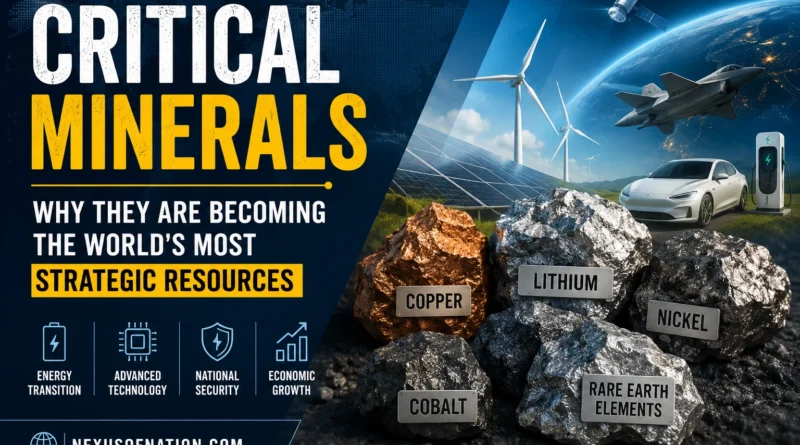
Oil had been the key to 20th century geopolitics. But it’s another set of resources that’s shaping the 21st: critical minerals, the lithium, cobalt, rare earths, gallium and dozens of other materials that run everything from smartphones to fighter jets to the entire clean-energy transition. For the last two years these minerals have been a side issue of great-power competition and 2026 is the year they have become a no longer ignorable issue.
Key Takeaways
- China accounts for 47% to 87% of global refining capacity in critical mineral supply chains and up to 94% of some processing stages, per data from International Energy Agency.
- Fourteen of the 33 most important minerals that the U.S. depends on are mainly supplied by China, such as gallium, tungsten, and rare earth elements.
- As part of a $340+ billion plan to invest in a clean energy value chain, Chinese entities have been investing over $120 billion in mining and processing projects overseas since 2023.
- Despite a partial trade truce with the US, China’s export volumes of critical heavy rare earth elements continued to run about half of pre-control levels as of May 2026.
- To counter this, the US in February 2026 proposed a preferential trade bloc with pro-U.S. countries to create supply chains free of China and introduced a critical mineral reserve Project VAULT.
- The EU has listed 60 Strategic Projects, including in EU countries as well as partner countries such as Canada, Kazakhstan and Zambia, focused on lithium, graphite, cobalt, nickel and rare earths.
The Need for Minerals and the Urgency of that Need
The critical minerals are the foundation of most strategic technologies in use today, from batteries and semiconductors to permanent magnets, wind turbine components, missile technology and AI hardware, and are found in a few countries geologically, and processed in even fewer. It’s the processing of that raw material into useful critical minerals that’s the real deal: A host of countries have deposits, but few are able to process the raw ore into something useful and it’s that that is the leverage. The industry is being defined more and more as a tipping point from a commodity industry to an industrial system competition.
China’s Structural Advantage
But, importantly, China’s command of this sector is not coincidental, but rather the result of decades of conscious industrial policy and the fact that China is now so dominant that it is said to be more a portfolio manager than a commodity buyer when it comes to managing a global portfolio of strategic commodities. That’s staggering, China holds a majority stake in over 60% of the critical mineral projects in Africa and South America, and thus has outsized influence over critical mineral supply even though it doesn’t own the underlying deposits. That superiority has increasingly turned into an instrument of state power and no longer just an economic consequence. China has been gradually increasing restrictions on materials, including gallium, germanium and graphite, since early 2023. In January 2026 it added rare-earth compounds (such as samarium, gadolinium and lutetium) and silver to its export licensing catalogue. In March 2026, China’s State Council took matters further by releasing a comprehensive framework on supply chain security that incorporates export control, investment screening and data security requirements into one national security regime, which subject foreign Companies operating in China to compliance requirements that extend beyond the purchase of critical minerals.
The West’s Countermove
Washington’s reaction has been similarly ratcheted up. Last month in February 2026, the US administration actually put forward the idea of creating a preferential trade bloc specifically to coordinate pricing and investments in critical minerals, in order to establish supply chains not dependent on China, but the plan has reportedly already encountered some initial pushback over pricing principles among member countries. From the defence side, the Department of War issued a call for proposals with its defence Industrial Base Consortium in March 2026 to increase sources of 13 key minerals specifically for semiconductors, weapons systems, and defence applications a move done, interestingly, one day prior to US strikes on Iran, and which now links mineral security with military planning in an unprecedented way. Domestically, the US set up a separate critical minerals reserve in February 2026 for public and private use, known as Project VAULT, as part of a broader strategy that also aims to increase the country’s extraction and processing capabilities and to sign bilateral cooperation agreements, such as a strategic critical minerals framework agreement with India in May 2026.
Europe & Middle East Enter the Race
Meanwhile, the EU has identified 60 Strategic critical minerals Projects for lithium, graphite, cobalt, nickel and rare earths, 47 of which are in its own borders, and 13 in countries with which it has strategic partnerships, such as Canada, Kazakhstan, Ukraine and Zambia, more attention is now being paid to processing capacity than to extraction. The ResourceEU Action Plan is designed to mobilise up to €3 billion by 2029, but has been disappointed by the uptake in investment compared to the policy frameworks developed to support it. The flow of new capital is also coming: UAE and Saudi Arabia have increased their funding demand for critical minerals and the EU had its first EU-Saudi Business and Investment Dialogue on raw materials in 2026, marking a new trend in the diversification of Gulf capital away from oil and gas.
Was there any change as a result of the Truce?
Earlier this year, some tensions were eased with a partial US-China trade truce, but the numbers don’t reflect a viable restoration of the previous situation. Despite the formal end of hostilities, exports of crucial heavy rare earths from China were still about 50 percent lower than they were before the controls were imposed as of May 2026. That’s a key difference for businesses relying on these materials as a truce in written form has not yet resulted in consistent and reliable supply conditions as before 2023.
Looking ahead what it means
Here are some dynamics that will influence the next stage of this contest:
- The true battle will be in processing capacities, not just mining. Almost all major initiatives, whether EU’s Strategic projects or even the domestic strategy of the US, are now clearly focusing on not only securing raw deposits but also improving the refining and processing capacity.
- Security of critical minerals is becoming an integral part of defence policy. As the United States calls for a larger share of critical minerals supplies just before the military action in the Middle East, it is obvious that both areas are now inextricably linked.
- New money is coming from unexpected sources. Even if the diversification is still years off and can’t match the current size of China’s production, Gulf state financing, the cooperation between Brazil’s rare-earth miners with Western firms rather than Chinese ones, and the new India-Australia-Japan-US partnership are all signs of a real diversification effort underway.
- Global trade could bifurcate further. A number of analysts now talk of the critical minerals market being bifurcated, into competing markets, instead of a single global market, with implications that extend to the entire critical minerals industry.
A Note on Sourcing
The International Energy Agency (through multiple secondary sources), ODI, US Naval Institute, and standalone geopolitical analysis sources have reported and analysed the following information for 2026. The reader should be mindful that this is a rapidly changing area and actual numbers in the context of specific developments may vary after publication due to the latest export control measures, trade proposals and bilateral agreements.
