
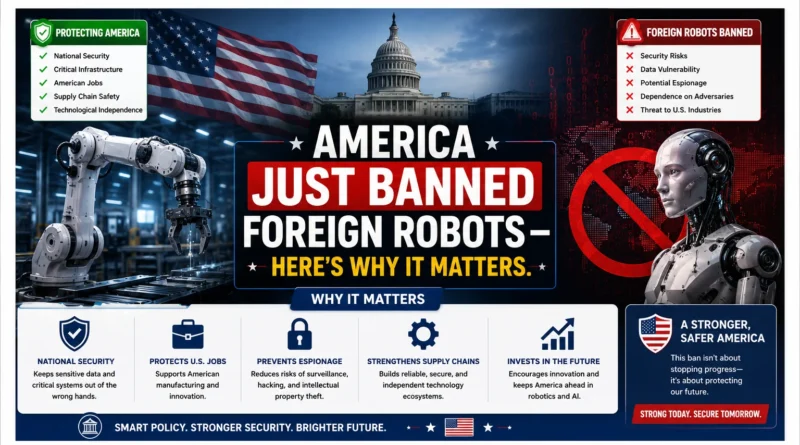
America Just Banned Foreign Robots — Here’s Why It Matters
What Happened
America just banned foreign robots: the FCC approved a ban on the import of foreign-made humanoid and quadrupedal robots, as well as new power inverters that connect batteries, solar panels, and data centers to the grid this week. The decision added these products to the FCC’s “Covered List” of items subject to future authorisation (not an immediate ban on already purchased products) due to national security concerns. According to the President’s task force, foreign-made robotic systems pose an unacceptable security and public-safety risk that is exacerbated by the potential for supply-chain vulnerabilities – which banned Chinese drones and Wi-Fi routers in the first place, Biden administration officials confirmed.
Why China, Specifically
America just banned foreign robots, as a part of the general trend to decouple China, although these rules do not explicitly mention the country. Chinese companies dominate the humanoid robot market, controlling approximately 85% of the world market. Unitree and AGIBOT are expected to bring in 5,000 each of the 15,000 projected humanoid robots in 2025. Meanwhile, Unitree utilises Nvidia’s Blackwell chips to process data from its robots, despite the stop of data processing in America. Indeed, the trend of restricting Chinese technology is part of the United States’ broader policy of economic decoupling from China, which has already manifested itself in bans on drones, routers, semiconductors, and AI models.
The Timing Is Not An Accident
America just banned foreign robots, just weeks prior to a planned September summit between President Trump and Chinese President Xi Jinping. Analysts note it as the latest flash point in the relationship between the two nations, which has been characterised by their leaders as one of intense competition and cooperation in equal measure. It serves as a warning shot before a meeting between the two presidents, which Beijing seems particularly interested in hosting. The foreign ministry spokesperson Mao Ning accused the U.S. of using protectionism to make itself “more competitive,” but she suggested that it would ultimately damage America’s own competitiveness, with impacts on firms and consumers that rely on cheap robotics technology.
What It Actually Changes
- America just banned foreign robots that, for American firms hoping to develop humanoid robots (a field in which they are currently far behind the rest of the world) is a blessing.
- NVIDIA, for example, recently put out a reference design for one such robot, and now there is an entire domestic industry that will see the competition for robotic device authorizations reduced by one large potential player
- For everyone else, it might not make much difference, for the time being. The rules simply restrict importation and authorization for new devices, rather than removing already-existing ones from the market.
- Analysts expect some impact on sales of Chinese robotics firms, but it will likely be minor, as the competition between the two nations has already factored into the prices and margins of many firms.
- The bigger picture, however, suggests that robots are joining drones, wi-fi routers, semiconductor manufacturing, and AI models on the list of technologies with significant supply chains in both economies.
Who’s Watching Closely
America has prohibited foreign robots, and, aside from the obvious players, several other parties have an interest in the outcome. Domestic robotic companies can benefit from taking over the sales while restrictions are imposed or eased. The chip manufacturers such as Nvidia have to consider their export limitations and the customer base that is not affected by the dispute. Other companies that were planning to purchase cheaper Chinese robots for their logistics and warehouse operations may have to reassess their expenditures.
The Bigger Picture
America just banned foreign robots even on the premise that humanoid robots are a distant future, existing only in a few isolated examples, and therefore difficult to assess their economic impact on society. Morgan Stanley estimates that robot demand will be worth $15 billion in 2030, which is still a long way ahead. However, the measures taken by the FCC will undoubtedly force companies to prepare for a confrontation of the two powers in the field of technology. It remains to be seen whether this is the right step in the race between America and China for technological dominance over the other, which will most likely be known after the meeting between Trump and Xi Jinping in September 2026.
A Note on Sourcing
This is a very newly-announced policy, and there are still more details to be shared by Beijing and by those impacted by the new order, as more time passes. The information included here comes from reports by Associated Press (via ABC News , CBS News , and Spectrum News ), NBC News , The Washington Post , Forbes, NPR (via All Things Considered ), and The Hill , as of July 29th, 2026. To follow along with similar news and analysis on global technology policy, and international relations between the U.S., China, and other nations, check out the Nexus of Nation website.
