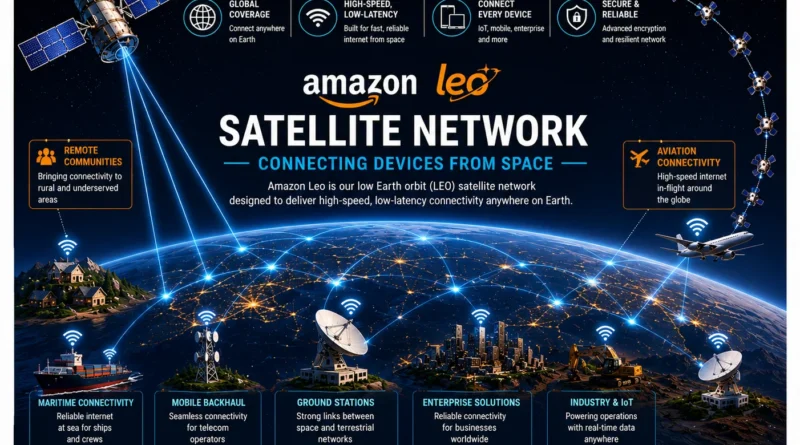
Amazon Leo Satellite Network – Connecting Devices From Space
Study Findings
- Amazon Leo satellite network filed an application with the Federal Communications Commission to deploy up to 5,105 satellites for its new direct-to-device (D2D) network
- The system that will use satellites to provide voice, messaging, data, and emergency services to compatible cellphones and other mobile devices beyond the reach of terrestrial cell towers.
- The network will rely on Amazon Leo’s satellites plus spectrum, satellites, and ground stations from Globalstar, which Amazon is poised to acquire
- Amazon has projected that satellite launches for the new system would begin in 2028, building on its broadband satellite network, in which nearly 390 of its satellites already orbit the earth.
- The filing comes as Amazon’s competition with SpaceX’s Star link heats up, while raising interesting questions about frequency-sharing with Iridium, a company Rocket Lab is set to acquire
What Amazon Leo Filed For
Amazon Leo satellite network has a parent company Kuiper Systems LLC filed an application with the FCC on Friday, July 24, 2026, requesting permission to deploy up to 5,105 of its satellites to provide direct-to-device cellular service. Amazon asked the FCC to approve the application, and the company hopes to start launching satellites for the new system in 2028, according to the document. If the application is approved, it would mark a significant step up for Amazon in its efforts to compete with SpaceX in the direct-to-cellular satellite communications field.
How the Direct-to-Device Network Will Work
According to the filing, the new satellite constellation will span five orbital “shells” to provide cellular coverage from the densest urban centers to Earth’s polar regions. Amazon plans to utilise both its satellites and the spectrum, satellites, and ground stations of Globalstar – a company that Amazon is positioned to buy, as it announced in April 2026. Amazon notes that the new network is designed to work with any mobile phone, including “any of the growing number of smartphones from major manufacturers that have satellite-capable chip sets built in,” meaning that users would not necessarily need to buy new phones to access the system.
What Services It Will Offer
- The Leo D2D system will offer voice, messaging, data, and emergency services to mobile devices that are compatible with Amazon’s Low Earth Orbit (LEO) constellation, connecting users to terrestrial networks where cellular coverage is otherwise unavailable.
- According to Amazon’s filing, the services would be beneficial to cellular networks, beyond everyday consumers’ cellular connectivity needs, such as disaster response, fleets, worksites, and Internet of Things (IoT). Additionally, the VP of business and product for Amazon Leo, Chris Weber, disclosed on social media that their expectation is to begin deployment in 2028 and collaborate with partners to deliver the needed services.
- According to the filing, the Leo D2D system will benefit consumers in cellular-only regions and enable “greater speed and throughput to expand what they can do with their existing device.” Moreover, the filing emphasizes that the system is intended to give mobile phone users access to the internet in places where mobile phones are their only means of accessing the web.
The Bigger Picture: Amazon Leo So Far
The filing comes as Amazon Leo satellite network continues to gain ground in the broadband satellite market. The company has already sent more than 390 satellites to orbit the earth as part of its initial broadband system and projects to begin providing low-cost fixed broadband services over its initial coverage footprint this year. Amazon has secured numerous strategic broadband partnerships, including Vodafone, DirecTV, Herotel, and Australia’s National Broadband Network. The deal with Vodafone is particularly significant, as it seeks to use Amazon’s satellites to provide cellular backhaul to 4G and 5G mobile phone towers throughout Europe and Africa.
The Competitive Landscape
Amazon Leo satellite network not only creates a direct confrontation with SpaceX and its starlink direct-to-cellular project but also with the pending Global star acquisition. The issue is complicated by the fact that FCC Chairman Brendan Carr responded to Amazon’s criticism of SpaceX’s plan for a million satellites by saying that they should get their house in order before criticising others. In addition, the application to the FCC also creates a direct conflict with Iridium as Amazon’s Leo is asking for a unique use of Iridium’s frequencies while at the same time wanting to use the Iridium band for the company’s own purposes for the $8 billion expected to be spent on the deal.
Regulatory Path Ahead
The FCC has opened Amazon’s filing for public comments, which is standard practice for major satellite communications filings, as regulators consider whether to approve the application. Amazon’s application states that its satellites will share frequencies with other satellite providers using the same frequency bands and will take “all required and practical steps to avoid harmful interference,” so that other companies, including competitors, can use the spectrum alongside Amazon’s satellites without causing disruptions. At minimum, the comment procedures will ensure that the FCC considers whether to approve Amazon’s request to deploy nearly 5,000 satellites in light of the opposition from both SpaceX and Iridium.
Why This Matters
- Amazon Leo satellite network filing is part of a larger trend in the satellite industry in which companies seek to provide cellular connectivity directly to cell phones rather than requiring users to purchase separate satellite phones or rely on ground stations.
- If Amazon is successful, the Leo D2D system could provide cellular coverage to millions of cell phone users who do not have access to traditional cellular networks
- The filing has implications for the broader satellite internet industry, as Amazon, SpaceX, and others continue to work to create a global cellular network that provides internet access to mobile phone users beyond the reach of terrestrial cell towers.
A Note on Sourcing
This post is based on regulatory filings made just hours ago, and we expect updates as the FCC reviews Amazon’s application and responds to the concerns of competitors and other stakeholders, which Nexus of Nation will continue to follow closely as this story unfolds. Part of the research for this article was published by Reuters (via Virginia Business), Bloomberg, GeekWire, SatNews, Android Headlines, and Amazon in the form of a press release as of July 27, 2026.
