
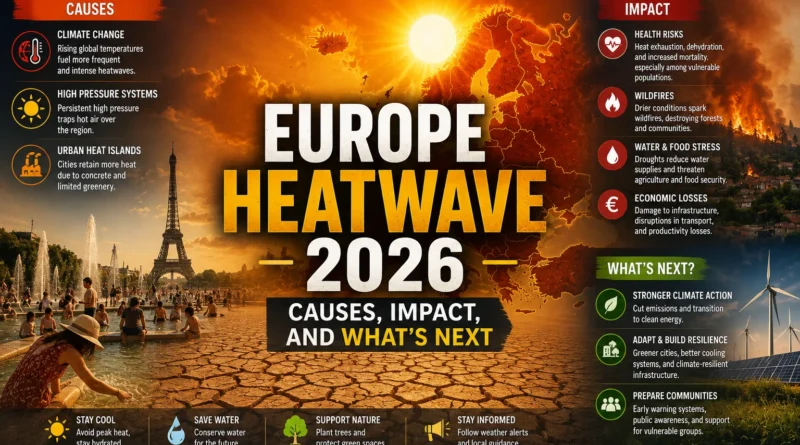
Europe Heatwave 2026 – Causes, Impact, and What’s Next
Key Points
- The Europe heatwave has seen a series of record-breaking events unfold since late May 2026, with June shaping up to be the hottest June on record for Western Europe
- The peak temperature reached 40.3 °C in Mora, Portugal, and 35.1 °C at Kew Gardens, England, which exceeded the UK’s previous record temperature on two consecutive days.
- The Europe heatwave of 2026 has already resulted in at least 15 people dying from water-related causes in the UK, while the overall number of heat-related deaths across the continent has also been severe
- The heat persisted throughout July, sparking wildfires in France and the Iberian Peninsula, and has shifted east towards the Balkans and Ukraine, as of late June
A Summer of Consecutive Heatwaves
Unlike previous warm episodes, the 2026 Europe heatwave manifested itself as a connected succession of heatwaves. It started on 22 May, with temperatures in western Europe being 10 to 15°C above average, reaching 40.3°C in Mora, Portugal, which is more than 2°C above the previous record. Another peak occurred several days later when the UK recorded its hottest temperature ever: 35.1°C in Kew Gardens. In June, western Europe’s warmest June (20.74°C, 3.05°C above average) tied with June 2025 for the warmest on record, while the continent’s hottest heatwave since records began scorched the Balkans and Ukraine, triggering wildfires in France and Iberia in early July.
You may also like: Major Policy Changes Around the World in August 2026
What’s Causing It: The Meteorology
According to meteorologists, the cause of the Europe heatwave was an ‘omega block’. This particular pattern is so-named because of its resemblance to the Greek letter Omega. Hot, dry air from North Africa becomes trapped by low-pressure systems formed on either side of the block. These kept temperatures across Europe 18°C above the seasonal average, during the peak of the June 2026 Europe heatwave. Part of the reason why it became so hot was due to the record-breaking temperatures across Europe’s oceans. The extra-polar ocean temperatures registered the highest sea surface temperatures for the month of June for the past century.
The Climate Change Connection
Scientists connected the extreme heat in the Europe heatwave with climate change, which made the situation significantly more probable. World Weather Attribution noted that, for the region that they studied, the June of 2026 was the warmest season thus far. The researchers found that such heat would be “virtually impossible” in June of 1976, and “highly unlikely at any time of year” for the same region. In fact, June is usually not the warmest month for the place that the scientists observed, which makes the Europe heatwave of 2026 even more surprising.
The Human and Health Toll
The global heatwave has led to significant casualties, exceeding previous records. Since the end of May, at least 15 people have died in UK due to water-related incidents, as they attempted to cool themselves in the rivers, lakes, and coastal areas of the UK. Furthermore, the number of casualties due to the heatwave on the European mainland is difficult to estimate, says WMO. For reference, the WMO cited that a similar heatwave that occurred in 2025 in Spain, during the summer months, has led to almost 16,500 deaths, 68% of which were related to climate change. It is possible that 2026 will see a similar grim statistic.
Wildfires and Drought
The heat and dearth of rainfall during Europe heatwave caused extensive wildfires and drought. The warmest temperatures and dry weather were observed in the Iberian Peninsula and southern France, while Eastern Europe was at significant risk of drought. Western and central Europe were also drier than average due to the high-pressure system that contributed to the heatwave. The rivers in France, central, eastern, and northeast Europe were below average at the beginning of the year. At the same time, Iceland, Ireland, most of the United Kingdom, coastal North Sea, Fennoscandia, Baltic region, and Greece were wetter and cooler than usual.
Must Read: Wildfires Spread Across Europe and Canada Amid Extreme Heat
Records Broken Country by Country
A number of countries broke national or regional records during the Europe heatwave 2026. According to the Wikipedia list of 2026 European heatwaves, Spain, the UK, Germany, France, Ireland set either national or regional temperature records during the 2026 European heatwave in May and June. The UK’s Met Office had issued a red extreme heat warning as the England and Wales temperature reached 30.9C during the June Europe heatwave. The 40.3C temperature in Mora, Portugal, was one of the highest recorded during the heatwave, whereas the 35.1C in Kew Gardens was the second day in a row that the UK tied or broke the record.
How 2026 Compares to Recent Years
- The Europe heatwave is part of a disturbing trend
- In 2025, Portugal and Spain saw temperature records of over 46 degrees Celsius for the hottest June day, and temperatures of over 46 degrees Celsius were also hit in at least ten other European countries, with the summer ultimately declared the hottest on record for Spain by scientists.
- Prior to that, the heat waves of 2022 were responsible for thousands of wildfires and significant drought, with hundreds to thousands of people losing their lives due to the disaster in individual countries
- Climatologists are linking these weather extremes to the jet stream, which is being influenced by climate change.
- The number of heat waves affecting European countries is rising at three to four times the rate of other northern mid-latitude areas like the United States.
What Happens Next
The WMO has called for increased efforts, calling the Europe heatwave “a sign of the times” and highlighting the importance of early warning systems, heat-health action plans, and building climate resilience. The Europe heatwave has moved east, causing hot, dry conditions in the Balkans and Ukraine and leading to wildfires in France and the Iberian Peninsula in mid-July. It is necessary to monitor the situation as, according to recent trends, another wave of record-breaking heat is expected to hit Europe, with temperatures in the Europe heatwave of 2026 already breaking the ones of June 2025. Scientists note that such heatwaves are set to become the norm rather than the exception for the European continent.
A Note on Sourcing
This is an ongoing Europe heatwave, which means that new information is being uncovered on a regular basis. The data used for this piece comes from news outlets and independent researchers’ reports, including those by the World Meteorological Organisation, the Copernicus Climate Change Service (C3S/ECMWF), World Weather Attribution, Euronews, and Wikipedia’s detailed page on the 2026 European heatwaves, as of 31 July 2026. Some of the statistics may still change as more details about the event and its effects become available. If you would like to stay updated on stories concerning the world and its climate, make sure to bookmark our Nexus of Nation page.
