
Why the Strait of Hormuz Matters – Oil & Prices
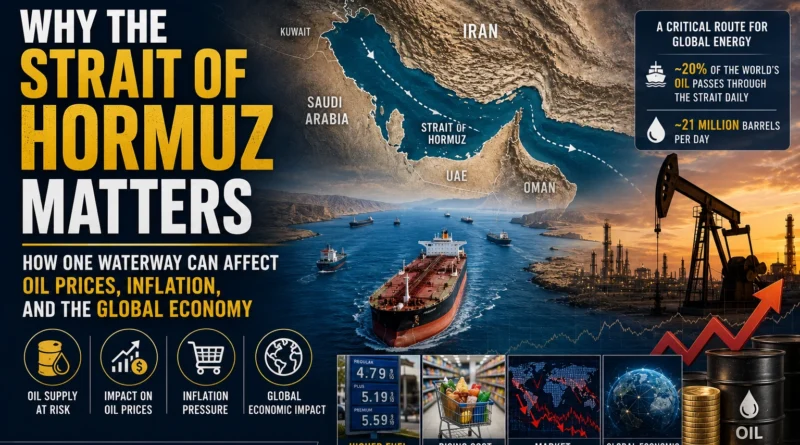
Reason why the Strait of Hormuz matters is evident from the fact that, despite being relatively narrow (21 nautical miles at its narrowest point), it is the shipping route of choice for 1/5 th of the world’s oil, LPGs, fertilisers, and gas. The closure of the Strait due to the 2026 Iran conflict had ramifications for the global economy. Below are the key insights regarding the implications and the most crucial facts about the significance of the Strait of Hormuz.
Key Takeaways
- The Strait of Hormuz witnessed a daily flow of 20 million barrels of oil on average, representing 20-25% of global seaborne oil trade.
- In addition, the Strait handles a third of world traded fertiliser, including half of the global urea and sulphur exports, which are critical fertilisers for food production worldwide.
- After the commencement of the 2026 Iran conflict, the number of tankers transiting through the strategic waterway was cut from the seasonal average of 138 per day to just one vessel in early March.
- Meanwhile, Brent crude oil prices climbed over 45% from the start of the year, and US gasoline prices hit the cost of $4.5 per gallon at the height of the crisis.
- According to the Federal Reserve’s research, if the Hormuz Strait gets blocked, it would propel West Texas Intermediate (WTI) crude oil costs to \$98 per barrel and lower annual global GDP growth by 2.9% for the highest scenario.
- Despite the reduced exposure to the chokepoint compared to the past due to only 0.5 million barrels of oil being imported daily from Iran via the Strait, compared to 0.7 million barrels in 2022, the US remains deeply integrated with the critical maritime route.
- Most of the allies’ oil imports from Iran, including Japan and South Korea, are subject to the same risk as most of their cargo passes through the narrow water area.
The Facts
The strait of hormuz is the world’s busiest “chokepoint,” through which 20 million barrels of oil pass on average daily, making of 20-25 percent annual global seaborne oil trade (35 percent for crude oil) (2), with alternative routes to the strait of hormuz being available for Saudi Arabia and the UAE, while Iran, Iraq, Kuwait, Qatar, and Bahrain have no other options. The strait is also by far the world’s most significant route for fertilisers with a third of global fertiliser trade and almost half of the global trade in urea, plus the majority of sulphur, transiting through the strait, which is of critical importance for the food supply.
The Impact of the 2026 Conflict Closures
The importance of the Strait of Hormuz became particularly evident in early 2026, after the Iranian Revolutionary Guard closed the passage to Western shippers. Only one vessel was reported to have passed through the strategic waterway on March 7, compared to a daily average of 138 before the blockade began. At the same time, tanker insurance became unavailable or prohibitively expensive. Consequently, oil deliveries dropped by 6 million barrels per day in Q1 of 2026, down by 30% from a year earlier. The cost of Brent crude reached over 45% of its peak during the conflict, resulting in gasoline prices across the United States exceeding $4.5 per gallon for several weeks.
Who Was Impacted by the Closure the Most?
While the closure caused significant disruptions to many oil-importing developing countries, it had a lesser impact on the United States. The country’s reliance on Gulf oil has decreased due to the shale revolution; the imports decreased by almost 30% since the year 2020 and amounted to about 0.5MMbbls in 2024. Japan remains the most vulnerable country as approximately 87% of its total energy needs are imported, half of which are sourced from the Middle East. It imports 1.6MMbbls of oil through the strait daily, posing a risk of stagflation if the seiche remains closed. Meanwhile, South Korea imported between 60-68% of its oil through the strategic waterway in 2024, equivalent to 1.7MMbbls/day on average.
Macroeconomics
Beyond just oil-importing countries, a prolonged closure would have negative implications for the global economy. According to the Dallas Fed, a closure would see WTI prices peak at $98/barrel, with the world’s GDP contracting by 2.9%. While a permanent closure seems highly unlikely, the episode in 2026 is a reminder that the oil market reacts strongly to supply disruptions, taking between 3-5 months to fully price a prolonged closure. The US is less vulnerable than it was before the shale revolution, but it is still more exposed than the pre-2016 levels. The 2026 incident was not unique, as the strait is the world’s most important shipping route, meaning that the ripple effects extend far beyond just the countries at either end.
A Note on Sources
This article was researched and compiled by Nexus of Nation, utilising the resources of the International Energy Agency, the US Energy Information Administration, the Federal Reserve Bank of Dallas, Brookings Institution, UN Trade and Development, the Institute for Energy Research, and The Global Statistics. The majority of the information provided in this article was collected from press releases commenting on the Strait of Hormuz situation in 2026. Therefore, some statistics might have been out-of-date at the time of publication.
