
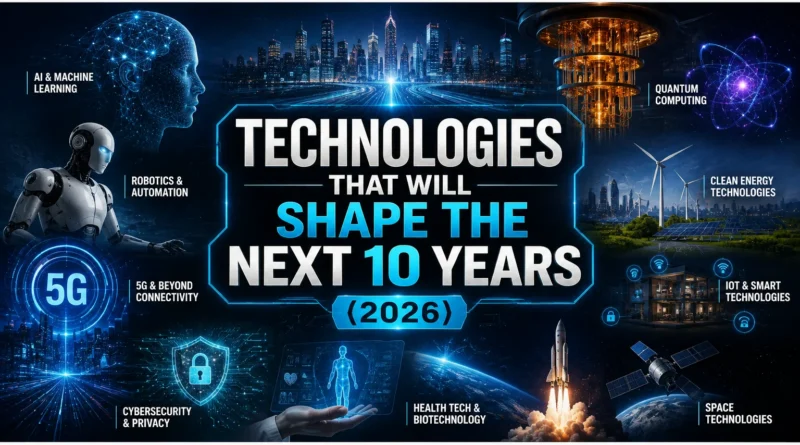
Technologies That Will Shape the Next 10 Years (2026)
The Highlights
- Technologies that will shape the next decade begin with artificial intelligence, which is shifting from chatbots and automation tools toward autonomous “agents” that can independently plan, reason, and complete complex tasks
- Robotics is moving out of warehouses and factories and into daily life, with cobots and humanoid robots increasingly working alongside humans
- Quantum computing is transitioning from research labs to real-world pilots in drug discovery, finance, and logistics, with the market projected to reach roughly $97 billion by 2035
- Biotech breakthroughs — including personalised cancer vaccines and brain-computer interfaces — are moving closer to real clinical use
- Energy, materials, and connected-infrastructure technologies are quietly underpinning nearly every other trend on this list
10 Technologies Set to Define the Next Decade
1. Agentic AI
Technologies that will shape the next decade start with artificial intelligence, which has shifted from experimental pilots to everyday business reality, with algorithms streamlining back-office work and chat bots handling millions of customer interactions. The next phase is agentic AI — systems that independently break complex goals into sub tasks, execute them, and learn from the outcomes with little or no human intervention. US enterprise adoption of generative AI surged from 11% to 65% between 2023 and late 2024, with productivity gains of up to 34% in some use cases, signalling that AI agents are quickly becoming operational infrastructure rather than experimental add-ons.
2. Robotics and Physical AI
Intelligence is no longer confined to screens — it’s becoming embodied and autonomous, solving problems in the physical world. Amazon has already deployed its millionth warehouse robot, with its DeepFleet AI system coordinating the entire fleet to improve travel efficiency by 10%. Beyond warehouses, “cobots” — collaborative robots designed to work directly alongside human teams in manufacturing, logistics, and assembly — are one of the fastest-growing segments of the robotics market, which is projected to reach $88.3 billion in 2026 alone.
3. Quantum Computing
Quantum computing was largely confined to research labs until recently, but its first real-world applications are now emerging. Pharmaceutical companies are using quantum simulations to accelerate early-stage drug discovery, banks are testing quantum algorithms for portfolio optimisation and fraud detection, and logistics firms are modelling more efficient delivery routes. Quantum technologies as a whole are projected to generate up to $97 billion globally by 2035, with public investment in quantum startups jumping sharply in recent years.
You may also like: America Just Banned Foreign Robots
4. Personalised Medicine and Biotech
Among the technologies that will shape the next decade, health and biotech are moving toward genuinely individualised treatment. Personalised cancer vaccines, tailored to a patient’s specific tumour profile, are among the technologies the World Economic Forum has flagged as moving from research into real-world deployment. Breakthrough CRISPR gene-editing results are also accelerating the pace at which precision medicine can move from the lab to the clinic.
5. Brain-Computer Interfaces (BCIs)
Once the stuff of science fiction, brain-computer interfaces are among the technologies that will shape the next decade, edging closer to practical reality. A BCI establishes direct communication between the electrical signals of the human brain and an external device, such as a computer or a prosthetic limb — technology with major implications for people with paralysis, neurological conditions, and disabilities, and one that’s expected to see continued advancement over the next decade.
Must Read: Amazon Leo Satellite Network
6. Extended Reality and Spatial Computing
Augmented and virtual reality technologies aren’t new, but spatial computing — the underlying technology that enables extended reality (XR) — is poised to bring a new generation of AR and VR into mainstream use. The XR industry is projected to grow at a 33.2% annual rate between 2026 and 2035, reaching an estimated value of $4.4 trillion by the end of that period, with AI and software improvements driving new use cases in medicine, manufacturing, and remote work.
7. Small Modular Reactors and Next-Gen Energy
Among the technologies that will shape the next decade, energy innovation is quietly underpinning much of the rest of this list, since AI, robotics, and quantum computing all demand enormous amounts of power. Small modular nuclear reactors (SMRs) are one response: the SMR market was valued at $6.7 billion in 2025 and could reach $10.9 billion by 2035, with 2026 expected to bring a dramatic acceleration in testing and supportive policy.
8. Sustainable Materials Innovation
Alongside energy, materials science is undergoing its own transformation. Technologies like direct lithium extraction and PFAS destruction are among the innovations the World Economic Forum highlights as moving from scientific breakthrough toward real-world scale, reflecting a broader push toward extracting essential raw materials and eliminating harmful “forever chemicals” more efficiently.
For You: US-India Space Partnership 2026
9. Smart Cities and Connected Infrastructure
Urban environments are becoming more interconnected, with sensors, devices, and data analytics forming networks capable of responding to a city’s needs in real time — traffic signals that re-calibrate based on live congestion, and waste systems that refine collection routes for efficiency. This shift is underpinned by expanding 5G networks, which have already reached roughly 3 billion subscriptions worldwide and can bring latencies down to as low as 1-10 milliseconds, compared to 30-50 milliseconds on 4G.
10. Next-Generation Cybersecurity
Every technology that will shape the next decade — from AI agents to quantum computing to connected smart cities — also expands the attack surface for cyber threats, creating new vulnerabilities that didn’t exist in earlier, less interconnected systems. Next-generation cybersecurity frameworks are emerging alongside these innovations, built specifically to address risks like quantum-resistant encryption and the security challenges posed by increasingly autonomous AI systems operating with minimal human oversight, particularly as these systems gain the ability to make consequential decisions without direct human review.
Conclusion
Taken together, these ten technologies that will shape the next decade point toward a convergence — digital, physical, and biological systems increasingly working together rather than in isolation. Some, like agentic AI and robotics, are already scaling rapidly inside real businesses today. Others, like brain-computer interfaces and small modular reactors, remain earlier in their development but are advancing quickly enough that their real-world impact by the mid-2030’s looks increasingly plausible rather than speculative. The common thread across all of them is that they’re no longer confined to research papers and pilot programs — they’re beginning to reshape how industries operate, how cities function, and how people live, work, and receive care. For continued coverage of emerging technology, visit Nexus of Nation.
FAQs
Which technology will have the biggest impact over the next decade?
Most experts point to AI, particularly autonomous AI agents, as having the broadest near-term impact, since it’s already being adopted across nearly every industry.
Is quantum computing actually usable today, or still theoretical?
It’s transitioning out of pure research, already being tested in drug discovery, fraud detection, and logistics — though widespread commercial use is still developing.
What are brain-computer interfaces used for right now?
Current BCI use — one of the technologies that will shape the next decade — is mostly medical, helping people with paralysis or neurological conditions control prosthetic limbs or computers using brain signals.
Why does energy technology matter for AI and robotics?
AI models, data centres, and robotics require enormous electricity to operate at scale, which is why innovations like small modular reactors are being developed to meet that demand.
Will these technologies create or eliminate more jobs?
Most experts expect a mix of both — automation will likely displace some roles while creating new ones focused on managing and overseeing these technologies.
