Mecca Joint Defence Agreement – Pakistan, Turkey, Saudi Pact
Key Takeaways
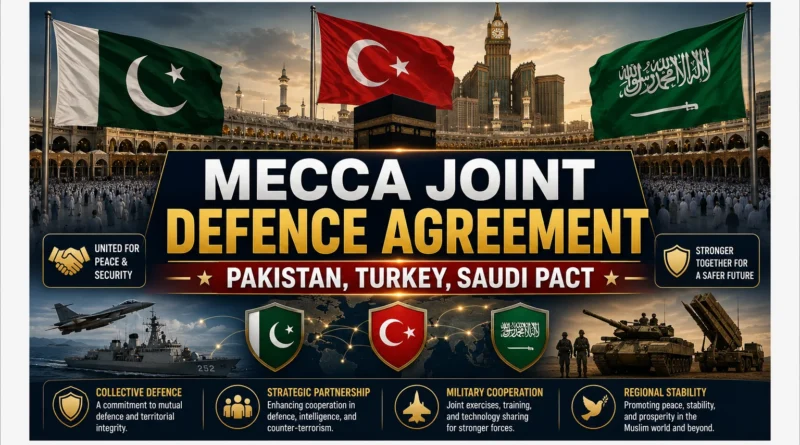
- Mecca Joint Defence Agreement: Pakistan, Turkey, and Saudi Arabia signed a landmark trilateral defence pact in Mecca on August 7, 2026, declaring that an attack on any one signatory will be treated as an attack on all three.
- The pact builds on the Strategic Mutual Defence Agreement Pakistan and Saudi Arabia signed in September 2025, with Turkey joining after months of talks driven partly by doubts about NATO’s reliability.
- Analysts stress this isn’t a full NATO-style mutual defence treaty, but a framework for deeper military, strategic, and defence-industrial coordination.
- The agreement brings together Turkey’s military and defence-industrial strength, Saudi Arabia’s financial and political weight, and Pakistan’s status as the Muslim world’s only nuclear-armed state.
- The pact could reshape US security relationships in the region, influence energy market stability, and raise questions about a possible nuclear dimension given Pakistan’s involvement.
The Mecca Joint Defence Agreement: How the Pact Is Reshaping Middle East Security
From Bilateral Pact to Trilateral Alliance
The Mecca Joint Defence Agreement didn’t come out of nowhere. It builds directly on the Strategic Mutual Defence Agreement that Pakistan and Saudi Arabia signed in Riyadh in September 2025, which had already established a collective-security understanding between the two countries. Turkey had reportedly been in advanced talks to join that framework since at least January 2026, a move driven in part by its own uncertainty about NATO’s reliability amid shifting US policy. The timing of this trilateral upgrade lines up closely with escalating regional turmoil — including the resumption of conflict involving Iran, Houthi strikes originating from Yemen, and growing doubts among Gulf states about how far the United States is willing to go as a security guarantor.
What the Agreement Actually Says
At its core, the pact establishes a collective-defence clause similar in spirit to NATO’s Article 5: aggression against one member is treated as aggression against all three. Regional security analysts have been careful to note, however, that this falls short of a full NATO-style mutual defence treaty. It’s better understood as a framework for deeper strategic, military, and defence-industrial coordination rather than an automatic trigger for military intervention. Each signatory brings distinct strengths to the table — Turkey contributes NATO’s second-largest military and a mature domestic defence-industrial base, Saudi Arabia brings financial firepower as the world’s top oil exporter along with regional political weight, and Pakistan offers battle-tested military experience as the only nuclear-armed nation in the Muslim world.
Why Each Country Signed
Saudi Arabia is using the Mecca Joint Defence Agreement to hedge against an emboldened Iran while confronting the limits of US deterrence guarantees, building a web of overlapping partnerships rather than depending on a single ally. Pakistan strengthens its strategic depth and deepens the security relationship it built with Riyadh in 2025, while reinforcing its long-standing defence ties with Ankara. Turkey, meanwhile, gains a seat at the center of a new regional security bloc, offsetting its own concerns about NATO cohesion while expanding defense-export relationships with wealthy Gulf partners.
The Nuclear Dimension
Because Pakistan is a nuclear-armed state, its formal inclusion in the Mecca Joint Defence Agreement alongside Saudi Arabia has drawn particular attention from regional security analysts and global observers alike. The agreement doesn’t explicitly extend a nuclear umbrella, but the implicit deterrent value of Pakistan’s arsenal is widely seen as part of the pact’s underlying strategic calculus, especially given Iran’s own nuclear ambitions in the region.
Regional and Global Effects Snapshot
- A new power bloc between Israel and Iran — Analysts suggest the pact could be the seed of a broader regional alliance positioning itself cautiously between Israel and Iran, wary of both but formally aligned with neither.
- Pressure on US security relationships — Growing Gulf and Turkish scepticism about Washington’s reliability could reduce US leverage in the region over time if Saudi Arabia and Turkey continue diversifying their defence partnerships.
- Energy market implications — A stronger security umbrella is intended to protect critical energy infrastructure tied to Saudi oil exports, a factor that could influence global oil price stability going forward.
- Possible expansion — With Turkey joining what began as a bilateral Saudi-Pakistan framework, there’s speculation other Muslim-majority nations could eventually be invited in, potentially evolving the pact into a broader multilateral security organisation.
What to Watch Next
- Whether the Mecca Joint Defence Agreement moves beyond symbolic commitments into joint military exercises, intelligence-sharing, or arms co-production.
- How Iran and Israel respond publicly and privately to the new alignment.
- Whether other Gulf Cooperation Council members formally align themselves with the agreement.
- How the United States adjusts its regional defence posture in response.
- Whether the pact influences ongoing ceasefire or diplomatic efforts tied to the broader Iran conflict and Houthi activity in the Red Sea.
Conclusion
The Mecca Joint Defence Agreement offers a striking signal of how Pakistan, Turkey, and Saudi Arabia are hedging against an uncertain security landscape, and the swift attention it has drawn from analysts shows just how closely the region is watching for signs of a genuine multi-polar shift. But with the pact stopping short of a full NATO-style commitment, Iran and Israel yet to formally respond, and questions still open about whether other Gulf states will align themselves with the framework, the picture remains far from settled. As the three nations move from political commitment toward concrete cooperation, governments and markets alike will be watching closely for what comes next. For continued coverage of global diplomacy and regional security, visit Nexus of Nation.
Frequently Asked Questions
What is the Mecca Joint Defence Agreement?
It’s a trilateral defence pact signed by Pakistan, Turkey, and Saudi Arabia on August 7, 2026, declaring that an armed attack on any one signatory will be treated as an attack on all three.
Is this the same as a NATO-style mutual defense treaty?
Not exactly. Analysts describe it as a framework for deeper military and strategic coordination rather than an automatic trigger for military intervention, distinguishing it from a full NATO-style treaty.
Why did Turkey join an existing Saudi-Pakistan agreement?
Turkey had been in advanced talks to join since at least January 2026, driven partly by its own uncertainty about NATO’s reliability under shifting US policy.
Does the pact involve nuclear weapons?
It doesn’t explicitly extend a nuclear umbrella, but Pakistan’s status as a nuclear-armed state is widely seen as part of the agreement’s underlying deterrent value.
Could other countries join the agreement?
There’s speculation that other Muslim-majority nations could eventually be invited into the arrangement, though nothing has been formally announced.
