US Policy Shifts That Could Affect Businesses in 2026
Key Takeaways
- US policy shifts, With the signing of the One Big Beautiful Bill Act (OBBBA) on July 4, 2025, U.S. policy changes are in place, with the 21% corporate tax rate and the 20% pass through deduction being permanent.
- Despite some tariff actions being overturned in court, some others are still in effect, and tariffs are highly volatile, the Tax Foundation estimates that tariffs under the Trump administration will cost the average US household about $900 in 2026.
- The first joint review of USMCA trade agreement is in July 2026, and could mean significant renegotiation with Canada and Mexico.
- China’s semiconductor manufacturing practices and its shipbuilding industry are being actively targeted by Section 301 investigations, as are foreign digital services taxes on U.S. technology companies and excess global industrial capacity, and additional tariffs are likely to be imposed.
- The maturation of clean energy tax credits is proceeding at a faster pace than anticipated, most commercial energy efficiency credits will expire by mid 2026 with most of the tax credit budget shifted to the larger tax cuts as part of OBBBA.
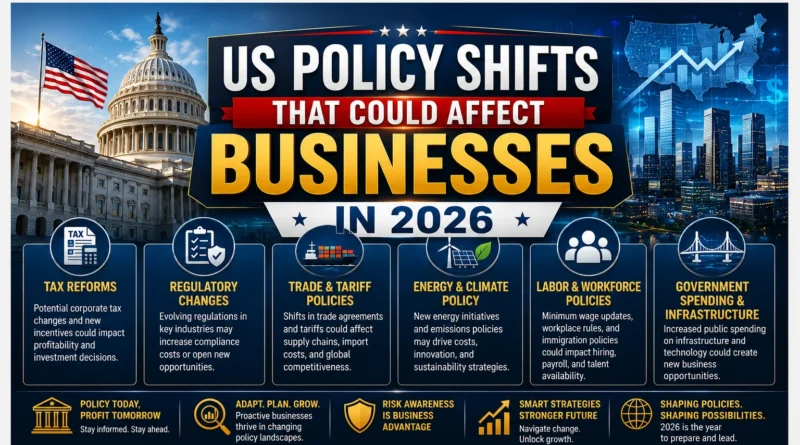
The following are the key U.S. policies that may impact businesses in 2026.
Tax Policy Changes
The OBBBA’s policy changes go beyond just a rate change in business tax planning. The law provides certainty by making the 20% qualified business income deduction for pass throughs permanent, while maintaining the 21% flat corporate tax rate. It also reinstates 100% bonus depreciation, allowing businesses to expense equipment and property costs upfront and throughout, instead of spreading the costs out over the years; and reinstates immediate R&D expensing and limit on interest deduction based on EBITDA. The biggest cuts in the tax liability are anticipated for the manufacturing, information and mining sectors in 2026.
Trade and Tariff Shifts are expected to be available
One of the most erratic factors for businesses this year is tariff policy. There are some tariff actions that have already been struck down by courts, such as Section 122 tariffs, which were invalidated by the Court of International Trade in May 2026, and new tariffs under Section 232 and Section 301 are being pursued by the administration. The Tax Foundation calculates these tariffs at $900 per US household on average in 2026, but with little to no significant impact on the trade balance. A July 2026 joint review by the USMCA could open the door to Canada and Mexico negotiations, and expect tariff refunds to be associated with any pending litigation.
Regulatory Rollbacks and Additions
Of the significant US Policy Shifts, clean energy policy is being reduced at a quicker pace than expected by a number of businesses. Obbba hopes to use the perks of the Inflation Reduction Act to help pay for its sweeping tax reductions; the clean vehicle and residential energy tax credits are scheduled to expire at the end of 2025 and most commercial energy efficiency tax credits, such as Section 179D deduction for new construction, will expire in the middle of 2026. On the compliance side, the 1% of taxable income limit on deductibility of charitable contributions by corporations is new and the following information reporting requirements by the IRS.
Trade Enforcement and Export Controls
The overall trade enforcement environment is changing. Export controls are getting bigger and sanctions programs are going broader and deeper into new areas such as those related to cartel activity and new outbound investment restrictions are altering the way U.S. businesses can invest abroad. The current Section 301 investigations cover China’s semiconductor manufacturing, foreign digital services taxes levied against U.S. tech companies, global industrial overcapacity in industries such as seafood, and more, with the potential to trigger additional tariffs or trade moves against global businesses that do business cross border.
Industry and Market Snapshot
- The bonus depreciation and R&D expensing provisions of OBBBA are providing the biggest tax benefits to manufacturing, information, and mining companies.
- Employers who invest in workforce benefits receive a significant boost in the incentive: The cap for the employer provided childcare credit will increase greatly in 2026, rising to $500,000 per year ($600,000 for certain small businesses).
- The businesses most affected by tariffs and those in the Section 301 review process have the greatest tariff-related cost uncertainty ahead of them for the remainder of 2026.
- Economists warn that it is difficult to isolate the effects of tariffs from other key factors (the AI and data centre investment boom, immigration policy changes and the overall reversal of past industrial policies). Businesses are challenged to predict the overall impact on job creation and prices.
Signals to Watch
- US Policy Shifts to track are any changes regarding the ongoing litigation regarding invalidated tariffs and if the administration seeks additional tariff authority under Section 232 or Section 301.
- The July 2026 USMCA joint review and whether it leads to renegotiation with Canada and Mexico.
- Major manufacturers SEC filings should give a more definitive picture of the actual mitigation costs and tariffs in 2025, which will be submitted in the next few months.
- Additional clarification by the IRS and webinars on implementation of the OBBBA business tax provisions in practice.
- All new executive orders and agency rule-making for export controls, sanctions, and Outbound investment restrictions.
Conclusion
Businesses are looking for more certainty surrounding tax policy with the U.S. Policy Shifts projected for 2026, but not from trade policy. While the OBBBA’s permanent tax measures provide a more stable long-term planning structure, the tariff uncertainty, export restrictions and on going trade investigations are leaving the overall picture of cost exposure very fluid, especially for import dependent and multinational companies, which are impacting global trade policy. Remaining on top of that will likely require a more active approach to monitoring of trade developments and planning through the remainder of the year. To follow the latest policy and business updates, please check out Nexus of Nation.
FAQs
What will the new tariffs do to small businesses?
Importers, particularly in industries that are currently subject to a Section 301 investigation, are most exposed to costs. The Tax Foundation estimates tariffs will cost an average household about $900 in 2026, which can be absorbed by both businesses and consumers in the supply chain.
Is corporate tax to be phased out in 2026?
No, in contrast to previous years, the OBBBA puts the 21% corporate tax rate to a vote and made it permanent, in addition to the 20% pass through deduction, providing businesses with greater certainty for planning long term.
Which sectors will benefit the most from the policy changes?
Bonus depreciation and R&D expensing changes are most beneficial to manufacturing, information, and mining companies, whereas import intensive industries and imported companies subject to Section 301 investigation (such as semiconductors and shipbuilding) are the most uncertain with tariffs.
So, is the USMCA trade agreement going to change in 2026?
The first joint USMCA review is set for July 2026, which may pave the way for negotiations among the US, Canada and Mexico to change some terms of the agreement.
Can businesses still take advantage of clean energy tax credits?
Most are being phased out at a more rapid pace than intended. The Section 179D deduction is included in the larger funding trade offs of OBBBA, which will expire by mid 2026.
