
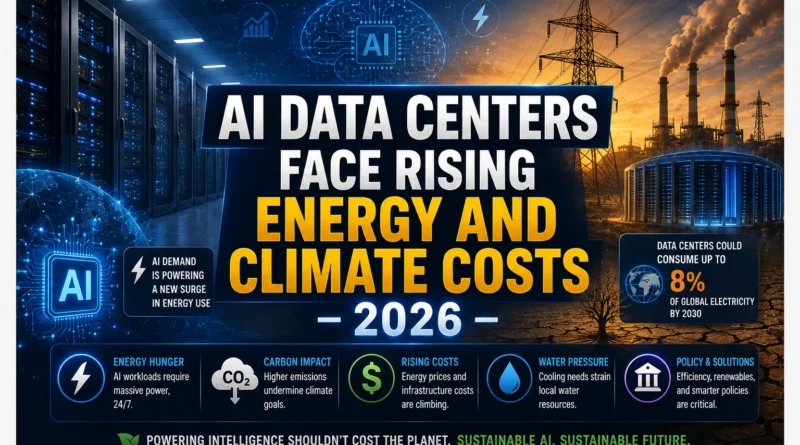
AI Data Centers Face Rising Energy and Climate Costs – 2026
Key Takeaways
- In 2026, global electricity consumption by AI Data Centers is projected to reach approximately 565 TWh, representing a 26.4% increase from the previous year’s 447 TWh.
- By 2030, data centers, AI and cryptocurrency are expected to use a total of 945 TWh per year, which is almost three times the combined electricity consumption of Pakistan, Bangladesh and Nigeria with a combined population of over 650 million people.
- A report by the Brookings Institution in March 2026 revealed that electricity prices have increased by 42% since 2019, and that utilities are seeking $31 billion in rate increases in 2025 alone.
- Through 2030, hyperscalers are expected to spend $7 trillion on infrastructure for their data centers world-wide, of which $2.8 trillion will be in the U.S. alone.
- Even with increased investment in renewable and nuclear power, the IEA predicts that natural gas and coal will provide approximately 40% of the extra data center energy demand by 2030.
AI Data Centers: New challenges in the area of energy and climate costs
To what extent is the energy demands of AI?
As AI has boomed, so has the demand for electricity in data centers. Along with the AI boom, data center energy consumption has exploded. Global demand was estimated to be about 565 TWh in 2026, 26.4% higher than 447 TWh in 2025, while IEA expects data centers to consume around 1,000 TWh in 2026, equivalent to Japan’s electricity use. If we look even further out, then the total data center, AI, and crypto demand could be at 945 TWh per year by 2030. As for the US, present electricity consumption at data centers is in the 180 TWh range, with plausible prediction that it will grow to 400-600 TWh by 2030 as AI workloads continue to expand.
Why are costs going up now?
The price explosion of AI Data Centers can be attributed to power-intensive devices. The typical rack was 5-10 kW in 2020; high density NVIDIA GPU racks are 60-120 kW, and next generation ones will be greater than 600 kW. Once air cooling exceeds 30-40 kW/rack, it no longer proves to be cost-effective and therefore has to be replaced by liquid cooling and immersion cooling. Pressure builds with grid constraints: Capacity auction prices have more than doubled in Northern Virginia, home to the world’s largest data center cluster, from 2024 to 2026/2027. Not only have electricity costs increased by 42% since 2019, according to Brookings, but utilities are asking for $31 billion in price increases just for 2025.
The impact of climate change
As AI Data Centers look into nuclear and renewable power agreements, the IEA estimates that natural gas and coal will account for approximately 40% of the increase in energy demand through 2030, as SMR technology is still years from deployment. In some Asian countries, coal is still the major fuel for power generation. With emissions still climbing despite the decarbonisation of most industries, data centres are one of the few industries where emissions are still on the rise, accounting for just 0.5% of global CO2 emissions. Water use is a secondary issue: liquid cooling results in a reduction of direct water usage of 70-90% compared to older systems, with an indirect water usage related to the water needed to generate the electricity.
Who’s Affected
The capital costs are falling on the hyperscalers, such as Microsoft, Google, Amazon and Meta, with their combined AI related capex for 2025 expected to be more than $355 billion, one of the largest infrastructure investment waves in history after governments. The price tag is not just on Big Tech’s balance sheets, however. As utilities continue to seek more power requests and grid capacity becomes increasingly constrained, many common ratepayers who live near big data center clusters are being pushed to pay higher utility rates. In total, about half of announced data center projects for 2026 have been languishing in the planning stage because of utility power demands and the shortage of power grid equipment.
Industry and Policy Snapshot
- AI Data Centers are increasingly seeking nuclear energy, including SMR energy deals, as a reliable and constant 24/7 base load power source for AI inference workloads, albeit SMR technology is still years from commercialization.
- In the short term, natural gas is filling the gap while clean energy implementations are being deployed more slowly, building tension with corporate climate commitments.
- The push for greater regulation of data center power usage continues, and data center operators are taking compliance planning into greater consideration when siting and constructing new facilities.
- Falling cost per task can paradoxically raise total energy use if it leads to higher overall demand, as the efficiency gains of new chips such as Trainium3 will be 30 to 40% better than the previous generations.
What Comes Next
- If and when hyperscalers nuclear and SMR commitments begin to yield actual operating capacity, or just as long-term promises.
- New cases for utilities and new regulatory decisions relating to data center power usage, especially in the Northern Virginia region.
- Major cloud providers will release earnings announcements of capital expenditures on AI infrastructure and future energy sourcing plans.Earnings updates from cloud giants on capital spending on AI infrastructure and energy sourcing strategy.
- If next generation, more energy efficient chip designs are able to meaningfully reduce total electricity demand, or if they just allow for more compute to be built.
Conclusion
The energy need of AI Data Centers is no longer a technical detail but has become an economic and political concern, directly impacting utility costs, climate goals, and grid facilities. In fact, the industry’s next big hurdle is not only to add more data centers, but to prove that it can power them without sacrificing climate commitments or driving away communities living near the facilities, a balance that is now playing out in the wider future of global energy policy, as hyperscalers commit trillions to new capacity and costs and emissions continue to rise. For continued coverage of technology and energy developments, visit Nexus of Nation.
FAQs
Here is the FAQ section with the questions as H3 headers and answers as paragraphs:
What are the reasons for consuming this much energy in AI data centers?
The server racks for AI workloads are much more power-hungry than conventional server racks, given that current high density racks use 60-120 kW, as opposed to 5-10 kW for a typical rack in 2020.
Are tech companies investing in renewable or nuclear energy?
Yes. Hyperscalers are also working to obtain firm-fixing for nuclear power, particularly in the form of the SMRs, hoping these will be available when they need them, but they’re not expected to be in full commercial production for several years, so natural gas is expected to hold up for much of the interim.
Will this increase the cost of electricity to consumers?
Observing this is an increasing worry. The debate has been brewing for some time, as electricity prices at the start of 2025 have increased by 42% compared to 2019, and utilities are seeking rate hikes totaling $31 billion in 2025, with data center demand cited as a factor in some areas.
What is the real CO2 emission of data centers?
The CO2 emissions from data centers make up about 0.5% of global emissions, while emissions in most other sectors are decreasing as they strive to reach carbon neutrality.
But what about data centre water consumption?
Yes. Liquid cooling systems are used much less in direct water consumption than other, older techniques, but they have an indirect water usage associated with the electricity that operates them.
