
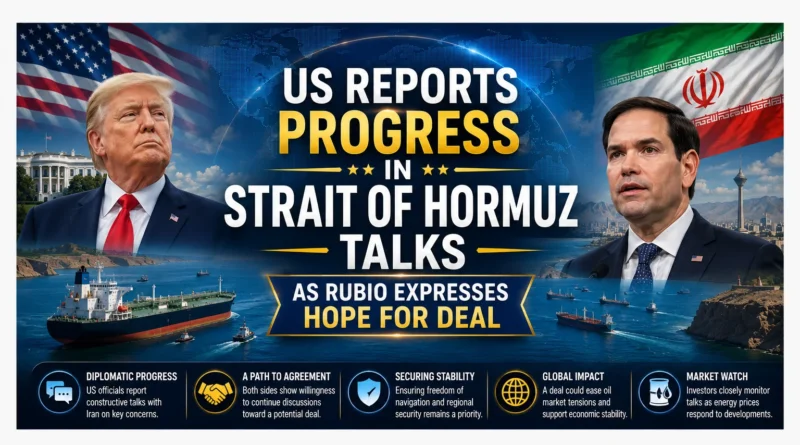
US Reports Progress in Strait of Hormuz Talks as Rubio Expresses Hope for Deal
The United States voiced some cautious optimism over Strait of Hormuz talks with nations on Tuesday, with U.S. Secretary of State Marco Rubio telling reporters at the State Department that there’s been progress made in those talks, but not finality yet and we’re hoping that will happen very shortly. His remarks coincided with a wider diplomatic effort by a number of regional actors. The comments have attracted international attention, with oil markets and Wall Street responding nearly instantly when one of the flash points in the United States and Iran conflict appeared to be coming to a head, for once in months, there has been a moment of relief.
The Strait of Hormuz and its significance.
The Strait of Hormuz is a narrow seaway between the Persian Gulf and the Gulf of Oman and the Arabian Sea that lies at the heart of Strait of Hormuz talks that are followed by the global markets. It is one of the busiest energy shipping routes in the world, and many of the world’s oil and LNG exports go through it to destinations in Asia, Europe and beyond. Clashes with the US have caused shipping to be disrupted through the strait in tandem with global oil prices, energy security, and financial markets since the conflict began earlier this year, and prospects for the return of normal shipping activity are closely monitored globally.
Who’s Actually Negotiating
The Strait of Hormuz is where the talks are taking place, Rubio explained, and the U.S. is participating in the conversation but not the parties. Though he didn’t specify, his immediate goal is the prevention of escalation, reopening the Strait and reopening the door to diplomacy in a greater battle against Iran’s nuclear program. Talking with Oman has been positive and about safe inbound and outbound routes, said Baghaei, Iran’s representative. An emerging deal may involve rerouting ships traveling to the Gulf near Iran and out of the Gulf near Oman, possibly charging the ships fees, officials told the AP. Trump is also said to be in talks with the emir of Qatar, a government official told the AFP that drafts of a wider deal are being circulated and in very progressive stages, but that there are no plans for direct US-Iran negotiations.
Treasury Secretary Bessent’s More Bullish Timeline
Even more optimistic than Rubio, Treasury Secretary Scott Bessent told CNBC that the US could make an agreement with Iran to reopen the strait “by Wednesday. We are in discussions with the Iranians, and I believe we could have a deal today or tomorrow, opening the strait and moving towards a more normalised position in this conflict, Bessent said. It would help stabilise energy prices, and would be good for sectors such as fertiliser and chemicals. In a separate statement, Iranian diplomatic sources in Tehran indicated that a deal could be reached by the end of Wednesday as well.
A Complex and Confused Landscape
Optimism has not been universal when it comes to Strait of Hormuz talks. Iran’s Foreign Ministry has refuted reports of any direct talks with Washington at all, and previous reports of a soon to be deal have been too hopeful. There is still ongoing tension on the ground as an unidentified object attacked a cargo ship off the coast of Oman Tuesday, but no group took credit for it. Yemeni’s Houthis have additionally claimed a raid on a Saudi airport and vowed to shut down the Bab el Mandeb entryway to Saudi ships. Analysts at Kpler were far less bullish, reporting the arrival of just a few ships each day, typically under 10 vessels, in Hormuz.
Market Reaction
Financial markets reacted swiftly to the news. Investors were pricing in the normalisation of shipping through the strait, which saw the prices of oil drop below the $80 range, from the more than $100 range at the peak of the US-Iran war. Wall Street surged with the slide, as the Dow, which had set an all time record the day before, rose further Tuesday, as did the S&P 500 and Nasdaq. The war has had mixed impacts on energy companies: BP’s net profit rose Tuesday to over $3.91 billion from just over $1.62 billion a year ago, as its primary business of oil and gas climbed in price throughout much of Q2 2026.
What Comes Next
- Trump says there are two phases to Strait of Hormuz talks, immediate agreement to reopen the strait, and broader talks on the larger conflict including Iran’s nuclear program.
- Qatari officials have not said when the deal will be finalized, but expressed that a deal will be reached as soon as possible.
- Today’s upbeat mood in Washington does not bode well for a deal being completed, analysts warn.
- This is partly attributable to how this conflict has evolved thus far, such as the denial by Iran that any talks are even in progress.
- Rubio and Bessent have hinted that the announcement may be made in days, but there’s no confirmation.
Conclusion
The positive development in Strait of Hormuz talks is a welcome sign of a step toward reducing tensions in the region and global energy markets, and the responding market action reflects the high level of investor scrutiny for a breakthrough. But since Iran has denied any direct talks, a projectile hitting a ship on the same day in the strait and previous rounds of imminent deals having stalled, the situation remains fluid. Meanwhile, governments, companies and financial markets will be closely watching to see if Wednesday delivers the final agreement in what has been a long process of speculating. To follow the world of global diplomacy and energy markets, go to Nexus of Nation.
FAQs
So what will be discussed in the Strait of Hormuz talks?
Iran and Oman are also discussing safe passage for commercial ships through the strait, which is to be supported by the US. It is proposed that the inbound vessels would be diverted near Iran and the outbound vessels diverted near Oman.
Does the US directly talk to Iran?
Not, according to Rubio, there has been direct talks between Iran and Oman with the United States backing the process. The Foreign Ministry of Iran has further stated that there are no direct talks between Tehran and Washington.
When is it possible to make a deal?
Treasury Secretary Scott Bessent said an agreement could be done today or tomorrow while Rubio was less specific, saying only that it could be done very shortly. As of Tuesday, there was no final deal reached.
What has been the response of markets to the news?
Oil prices dipped into the low $80s from a peak of more than $100 a barrel in the height of the conflict, and the Dow and S&P 500 and the Nasdaq joined the rally on the optimism.
Is the broader US-Iran conflict coming to a close?
Not necessarily. The event comes amid tension, including a projectile shot at a cargo ship the same day, and is Trump’s first of a two part process: reopening the strait, followed by wider discussions on Iran’s nuclear program.
