
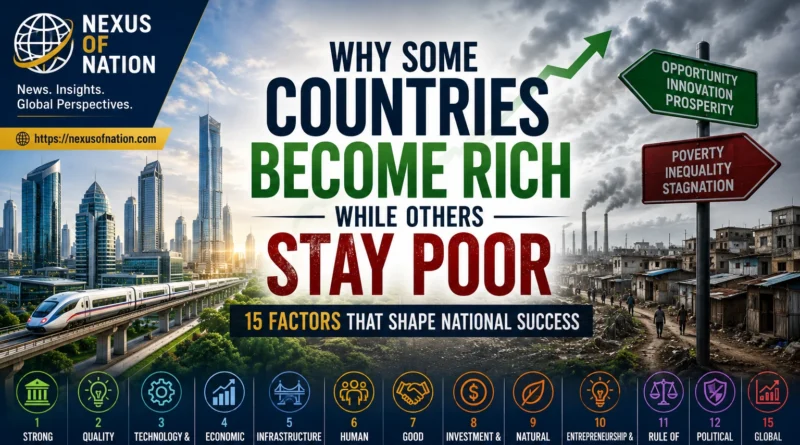
Why Some Countries Become Rich While Others Stay Poor?
The question of Why some countries become rich while others stay poor is a complex economic and political issue asked by Adam Smith himself. It seems that researchers and scholars have failed to come up with a solid and realistic answer because it appears that not one but several factors contribute to the wealth or poverty of a country. Therefore, there is still no scientific structure which would help understand the level of wealth or poverty of any particular country.
Key points
- Research presented shows that good institutions and external trade are the two most significant predictors of a nation’s economic success.
- The former includes the rule of law that protects private property, which leads to countries prospering, whereas countries with extractive institutions are unable to do so.
- The removal of trade barriers would reduce the income of the countries with the richest population by half, says the research conducted by the Federal Reserve.
- The impact of corruption is consistently negative, and the level of corruption determines the development of an economy depending on whether it is at an early or late stage.
- Education, as well as human capital in general, plays a crucial role in the development of any country.
- Finland and South Korea are good examples of countries that have invested significantly in education and yielded remarkable results.
Reasons
1. Institutions
According to Acemoglu and Robinson, institutions are the most significant factor in determining whether a country will thrive or remain in poverty. Their theory states that nations that have been ruled by inclusive institutions have prospered by securing property rights and promoting economic development. The researchers suggest that extractive institutions, which only promote the interests of the ruling elites, have ultimately kept societies impoverished. The researchers note that while geography plays a role in determining a country’s wealth, its influence is limited to institutional development.
2. Trade
Trade is the second most common explanation for the wealth discrepancy between countries. Researchers note that nations that engage in international trade are more likely to have higher GDP than those that do not. Additionally, the study shows that the more a country’s GDP depends on exports, the higher its economic growth is likely to be. According to the Federal Reserve research, if trade barriers were completely eliminated around the world, the wealth gap between developed and developing countries would reduce by approximately 50%.
3. Corrution
Corruption is a significant factor in determining the wealth or lack thereof in various countries. Research suggests that corrupt government officials and dishonest bureaucrats have a profoundly damaging effect on a nation’s economy. In fact, studies show that a country’s level of corruption directly impacts its overall prosperity. Additionally, research indicates that corruption and the overall level of economic development are intrinsically linked, creating a vicious cycle that is challenging to break for poorer countries.
4. Education
A country’s literacy rate and the availability of a qualified workforce are essential components of its economy. Nations with higher literacy rates and better access to education have an advantage over those without: a significant portion of the workforce can join the higher-growth industries and facilitate economic development. However, poor countries often lack access to basic education, negatively impacting their workforce capabilities in the long term. Additionally, many developing countries experience a brain drain, where their citizens move to another country to seek better work opportunities, depriving their homeland of skilled workers.
5. Political Stability
A nation’s political stability is directly linked to its economic growth prospects. Researchers note that politically unstable countries are unable to attract foreign investments or provide the security required for economic development. Additionally, politically unstable nations often find themselves in economic crises due to their leaders’ actions. Such countries are incapable of promoting long-term capital deepening, which ultimately affects their overall GDP.
6. Geography
The theory of geography was the dominant explanation for the wealth disparity between countries during the time of Adam Smith. According to this theory, the difference between nations is due to their location and natural resources, which give them an advantage over other countries. Although modern economists have found that institutions often have a far greater influence than geography, the availability of natural resources, and the influence of location on a country’s economy, remains significant.
7. Decentralisation
Research suggests that fiscal decentralization has a significant impact on a country’s economy. Analysis conducted by various researchers using cross-country data showed that decentralization has a positive effect on per capita GDP. The study also found that the effect of decentralization was consistent throughout different countries and throughout various points in time. In short, the researchers concluded that the concentration of power at a federal level negatively affected local economies.
8. Demographics
A country’s demographics determine whether it will continue to be a poor or a prosperous nation. Researchers note that a country with a high birth rate and adequate social policies to support its citizens is more likely to maintain its economic status or shift from poor to moderately prosperous. Meanwhile, a country with an increasing population but without the resources and social policies to support its citizens will see its economy stagnate or become poorer.
9. Total Factor Productivity
There are several factors influencing the difference in productivity between countries, namely the labor force and capital, with the latter being the most advantageous for economic growth. However, most researchers conclude that the most significant factor influencing a country’s wealth is total factor productivity. This theory suggests that most countries have the potential to experience economic growth as long as their labor force and capital are productive enough.
10. Foreign Aid
Researchers suggest that although foreign aid can have a positive short-term effect on a country’s economy, its effects are limited to emergency situations. Nations that rely on foreign aid to fund their operations do not experience sustainable economic growth since they do not develop the institutions and access to trade required to make the most of the resources.
11. Culture
Some researchers suggest that a country’s culture has a profound impact on its economy. Although it is impossible to accurately assess the significance of culture, there are many theories regarding the connection between cultural attitudes toward work, risk, and innovation, and the overall prosperity of a nation. Most researchers conclude that while culture rarely influences a nation’s wealth directly, it often interacts with other factors, such as institutions.
11. Resource Management
Research suggests that the management of resources and natural wealth is a significant factor in determining the wealth of a country. Nations that effectively utilize their natural resources and manage their economies experience economic growth. However, countries with abundant resources often find themselves in an economic crisis due to mismanagement, which has led many researchers to conclude that resource-rich countries do not necessarily become wealthy.
12. Rule of Law
The rule of law is an essential factor affecting a country’s economy. The rule of law encourages entrepreneurs and investors to operate in a nation, which ultimately influences its overall wealth. According to research, the credibility of a country’s legislation, its ability to protect property rights, and its ability to enter international agreements significantly impact its economic growth.
14. Innovation
Access to technology and innovation rates are essential to whether a nation grows wealthy or remains poor. Nations that promote the development and utilization of new technologies grow economically, whereas the ones that do not have access to them or disregard their implementation find themselves in a disadvantage, remaining at the same economic level instead of advancing.
15. History
Researchers note that the legacy of colonialism and historical relations between countries are significant contributors to the discrepancy in wealth between them. In short, nations that suffered from extractive institutional relationships throughout their history find themselves in poverty, whereas the ones that have promoted inclusive economic relationships throughout their history have become prosperous.
Why the factors matter
Why do some countries become rich while others stay poor? Research into the subject indicates that there is no single reason why some nations thrive while the others fail economically. Nevertheless, there are more consistent factors contributing to a country’s wealth, namely strong institutions and access to international trade. Geography, corruption, political corruption, education, and the overall rate of productivity affect a country’s economic status, with several of these factors being interrelated. All things considered, these factors affect the current wealth of countries, as well as their potential to grow economically, hence being vital to their national development.
FAQs
Why do some countries become rich while others stay poor?
Research suggests that a combination of several factors contributes to a country’s wealth and another’s poverty, with no single factor accounting for nations’ economic development. However, most researchers agree that strong institutions and access to international trade are the most consistent factors influencing a country’s economy.
What is the single biggest factor in national economic success?
According to Acemoglu and Robinson, institutions are the most significant factor affecting a country’s wealth, with nations that have developed inclusive ones prospering and those with extractive ones remaining impoverished.
Can a poor country become rich?
Research shows that a country that has been economically disadvantaged has the potential to become prosperous. For instance, South Korea and Finland were both relatively poor before they managed to invest in their institutions, education, and access to international trade, facilitating their economic growth.
Does having natural resources guarantee a country will be wealthy?
No, having natural resources does not guarantee that a country will be wealthy. In fact, researchers note that resource-rich nations often experience economic challenges due to mismanagement, which has led to the resource curse phenomenon.
How much could trade actually change the wealth gap between countries?
According to research conducted by the Federal Reserve, complete free trade would reduce the wealth gap between developing and developed countries by approximately 50%.
A note on sources
This article uses the research conducted by the Federal Reserve Bank of St Louis, Seven Pillars Institute, PhilArchive, and economic development research papers including the ones of Acemoglu and Robinson above. The topic of economic development has been researched extensively, with most of the studies concluding there is not one particular factor that makes countries rich, but rather several inter-playing ones, although there may be some consensus on the level of their influence – which is what the Nexus of Nation seeks to provide the readers with.
