
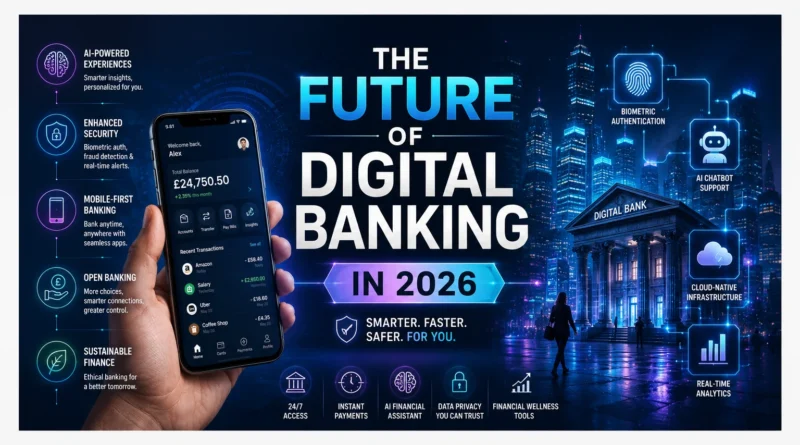
The Future of Digital Banking in 2026 – Revealed
Key Takeaways
- Meanwhile, the future of digital banking starts with neobanks becoming what they will be less digital accounts and more super apps, combining checking, lending, and investing into one mobile application, as global neobanking transaction values are expected to reach $333.4 billion by the end of 2026.
- Previously an early adopter feature, real-time payment infrastructure is becoming the new normal, and what used to take days of settlement for account-to-account transfers is now happening in seconds.
- Embedded finance is going deeper, with banking services brought right into retail, gig economy and marketplace apps without having to navigate to a separate banking app.
- From the front end (personalised recommendations, financial management tools) to the back end (fraud detection, risk monitoring, compliance), AI is transforming the banking industry.
- Decentralised banking has taken its first steps onto the road of a viable operating model, and regulated deobanks are starting to link blockchain transparency with banking compliance.
Neobanks become Super Apps
Digital banking begins with the neobanks, which have progressed beyond being just checking account alternatives. They are now continuing to bring together checking, lending, investing and other financial services in one app, becoming financial super apps. It’s no small scale by the end of 2026, neobanking transaction values are projected to reach $333.4 billion, with a compound annual rate of growth of 47.1%, while the number of neobank users in the world is expected to rise to 386.3 million by 2028. One factor contributing to this is specialisation. Instead, many neobanks are targeting a certain customer base – such as gig economy workers, Gen Z investors, or SMEs and provide highly personalised services to each.
Real Time Payments become the norm
For normal users, maybe nothing is more relevant than the transition to real time payments. One to three day wait times for account to account transfers are becoming history thanks to infrastructure such as FedNow and RTP in the US that enables settlement in seconds. The most important effect is for time sensitive transactions such as rent, business transfers, or urgent transactions, where the inconvenience or real cost of a multi day payment delay was previously significant. This is evolving to no longer be a luxury service, but rather a service that consumers will now look for when selecting a financial institution.
You might also enjoy reading these other posts about Embedded Finance
Embedded finance, meaning financial services integrated directly into the platforms you already know, not a standalone banking app, continues to grow and is a key facet of the future of digital banking. Today, banking can be found within retailers, social mobile apps, ride-haling apps, and marketplaces, with instant checkout credit or with built in savings functionality without forcing consumers to go elsewhere. The larger 2026 change is in B2B banking, where ERP integrated banking is on the rise, banking will be done directly out of the ERP via API, and the banking API will become the product. These days corporate clients demand real-time management of treasuries and automated FX hedging that can be integrated into procurement processes something that many legacy banks are still trying to achieve.
From the back to the front end AI is reshaping banking
Whether it’s in the foreground or the background, artificial intelligence has taken a strong hold in the operation of banking. In terms of their customer experience, things like AI-driven financial management, predictive credit offers, and frictionless onboarding are no longer differentiators. On the back end, AI is becoming a more integral part of fraud detection, risk monitoring, and compliance efforts, a need that’s essential in response to the increased sophistication of frauds alongside the creation of AI tools to combat them.
Open Banking and Data Portability
Open banking is a major piece of the future of digital banking: it is under development both as a regulatory and market driven initiative, and it is a framework that will enable third party developers, for example, budgeting applications, to access a customer’s bank account information in a secure way with the customer’s explicit consent. With the growing ability to securely move financial data between banks, fin-techs and third party developers, customers can have a much more comprehensive and singular view of their financial lives even if they have their money divided between several banks and applications.
Decentralised Banking moves From Experiment to real model
Among the more structurally impactful changes set to take place in 2026 is the rise of deobanks fully-regulated financial platforms designed on blockchain rails that blend the transparency and functionality of decentralised finance (DeFi) with the accessibility and regulatory standards of traditional banks. While neobanks focused on digitising the front-end banking experience, deobanks take it one step further, and reengineer the core for deposits, lending, liquidity and rewards to be handled autonomously and in a programmable manner, and compliance is built in to ensure that every banking action is audit ready. Governments and central banks are also starting to conduct trials on frameworks, such as MiCA in Europe and MAS in Singapore, which would enable decentralised institutions to function under appropriate KYC/AML regulations and maintain transparency on-chain.
Business Banking Undergoes its Own metamorphosis
In 2026, small and medium-sized business banking is being redefined, with speed, accuracy, and intelligence from the ecosystem becoming the table stakes for small and medium-sized banks. Corporate and small-business customers are increasingly demanding that same real-time, integrated experience that consumers enjoy from neobanks, and banks that are unable to shift their systems to support that are vulnerable to the more agile fin tech competition that is built around this type of infrastructure.
Security, Compliance and Trust as the Foundation
Without trust, none of these advancements are particularly significant, and 2026 is a testament to that. AI capabilities are evolving on the banking side and so are the sophistication and scope of financial crime attempts; therefore, cybersecurity and fraud prevention are not a solved problem but rather a continuous evolving priority. Digital identity verification and automated KYC/AML compliance is now being embedded at the core of banking systems, rather than retrofitted onto the end of them, and is becoming what the industry considers more of a requirement than a luxury.
The implications for consumers and businesses
- For the average consumer, the experience of the future of digital banking comes down to finding out if their main bank or financial platform offers the tools and features that are becoming commonplace in 2026, such as instant payments, built in financial management tools, and clear security measures.
- For companies, especially small to medium-sized businesses, the focus is on identifying banking partners that keep pace with the integration capabilities and speed that companies demand more and more from their accounting and procurement processes as they become more digital.
- Whether or not you’re in a SMB or enterprise, the theme that connects the two is the fact that financial services are no longer a place that people have to go to, but are integrated into the platforms and workflows people already use.
- The transition only takes place where there is trust, security and true usability.
A Note on Sourcing
It’s not a set and forget situation, as new infrastructure, regulation and adoption numbers are coming to fruition every day of the year and the future of digital banking is rapidly changing. The insights in this post are based on industry analysis from Innowise, SoFi, Ispirer, Softjourn (quoting KBV Research), and Back base (quoting Deloitte, Accenture, Capgemini, and McKinsey) and are based on information and projections as of mid 2026. To keep up with fin-tech and banking trends around the world, check out Nexus of Nation.
