How to Start and Grow a Small Business in the USA 2026
Introduction
start and grow a small business in the USA is the dream of millions of entrepreneurs who want to gain financial independence and control their own professional destiny. Indeed, there are 36.2 million small businesses in the United States, comprising 99.9% of all US companies, and 62.3 million people, or 45.9%, of the private-sector workforce. Small business owners play a significant role in the economy of the United States, and this article will reveal the best ways to start and manage a small business in the US in 2026, from funding and entity formation to marketing and long-term sustainability.
Why Small Businesses Are Important to the Economy
Small businesses are not just a political campaign issue, they are the backbone of the US economy, and knowing how to start and grow a small business in the USA begins with an understanding of exactly what that is. Small businesses comprise 99.9% of all businesses in the US, employ 46% of the private-sector workforce, and account for 43.5% of the GDP. For those considering how to start and grow a small business in the USA, this is both good news and bad news. The good news is that there is a tremendous amount of infrastructure and support for small business owners in the US.
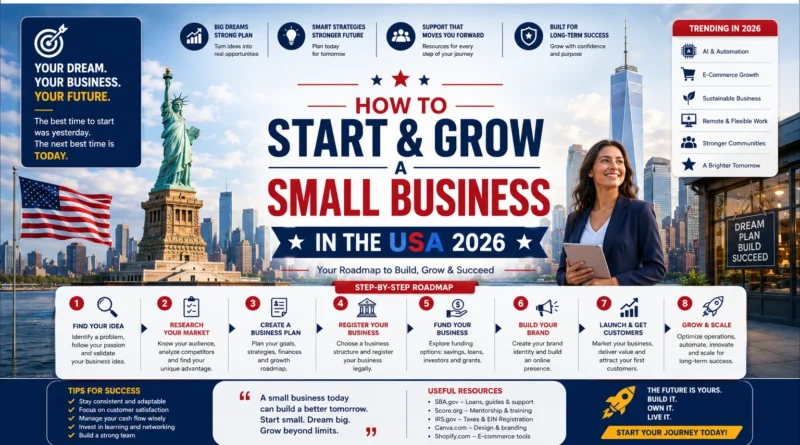
How to Start and Grow a Small Business in the USA: 5 Steps to Success
Research
- Before registering a small business, it is necessary to conduct market research to ensure that the proposed idea actually works in the marketplace:
- Talk to your customers: Conduct informal surveys or interviews before developing the product or service offering.
- Conduct a competitor analysis: Identify gaps in the market.
- Test the idea on a small scale: A minimum viable product or limited service offering can help reduce risk.
Forty-nine point four percent (49.4%) of small businesses fail within the first five years, and most of those failures are due to a lack of demand for the product or service offering. In other words, the idea itself was fatally flawed. That is why idea validation is the first step in learning how to start and grow a small business in the USA.
Legal Entity
- The tax, liability, and financing implications of a small business depend on its legal structure. The most common options are:
- Sole Proprietorship: Best for independent contractors, consultants, and other solo operators. No liability protection.
- LLC: Best for most small businesses. Simpler than an S-Corporation with fewer formalities.
- S-Corporation: Best for businesses that want to maximise tax savings.
- C-Corporation: Best for startups that plan to raise capital.
- Most small businesses in the US are structured as LLCs. A qualified CPA or attorney should be consulted when choosing a legal entity because the “best” option depends on individual circumstances, including income and risk exposure.
Financing
Most small businesses are initially funded through personal savings and/or bootstrapping, but other small business financing options include:
- SBA loans: Popular among small businesses, as they are typically easier to qualify for and have better rates and terms than conventional bank loans.
- Credit cards: Can be a good financing option for small businesses with high credit limits and responsible spending habits.
- Microloans: Community Development Financial Institutions (CDFIs) specialise in small business loans for entrepreneurs who cannot qualify for conventional financing.
- Friends and family: Can be a viable small business financing option, especially for angel investors.
Many small business owners do not pay themselves a salary early in the growth phase, funding their own compensation as the business grows and becomes more profitable. This is an important consideration for anyone looking to learn how to start and grow a small business in the USA, as it may be necessary to give up some discretionary income when leaving a full-time job.
Legal and Tax Considerations
There are several legal and tax considerations for small business owners in the US:
- An Employer Identification Number (EIN) from the IRS is required, even for businesses with no employees.
- Business licenses are required in most states, and those licenses typically must be renewed every year or every few years.
- Sales tax permits are required in most states for businesses that sell products and/or services.
- Independent contractors must be correctly classified as employees or independent contractors.
- Estimated tax payments are required on a quarterly basis by default for self-employed workers and pass-through entities.
Marketing
There are several marketing channels that are particularly important to small businesses, including:
- Local SEO: Most important for small businesses with a physical location or those that only serve local customers.
- Email marketing: Most important for small businesses that cannot afford traditional marketing.
- Social proof: Most important for local and service-based small businesses, as customers rely on reviews and word-of-mouth when making purchasing decisions.
It is much better to do one marketing channel exceptionally well than to do five channels only so-so. Most small businesses make the mistake of trying to do too much at once and then under-performing in all areas. It is common for small businesses to outsource at least some marketing tasks so that they can focus on their core competencies.
Trends in Small Business in 2026
- Most small businesses are using artificial intelligence in some capacity in 2026. Fifty-six percent (56%) of small businesses use some form of artificial intelligence in 2026, including chatbots, content creation tools, bookkeeping software, and scheduling tools.
- Most small businesses are home-based or non-employer businesses. Over 82% of small businesses in the US are non-employer businesses, meaning that they do not have any employees. This is a significant shift from previous decades and has implications for everything from financing to marketing to taxes.
- Most small businesses are concerned about inflation and cash flow in 2026. Rising prices are the number one concern for small businesses in 2026, edging out worries about the quality of employees and taxes.
- Most small businesses are optimistic about the future. Ninety-four percent (94%) of small business owners expect to see growth in 2026, despite inflation and cash flow concerns.
Common Mistakes to Avoid
- Under pricing to get customers and then struggling to raise prices later: A common mistake made by small businesses that want to learn how to start and grow a small business in the USA on a budget.
- Mixing personal and business finances: This is a mistake that not only complicates taxes but also defeats the purpose of an LLC.
- Scaling too quickly before being ready: Many small business owners try to grow their businesses too quickly and then fail because they do not have the infrastructure in place to support that type of growth.
- Focusing on revenue over cash flow: Many profitable small businesses fail because they do not have enough cash on hand to pay bills, even though they are technically profitable. This is why it is important to have cash reserves. The average small business only has enough cash to last for 27 days, and cash flow issues are the primary reason why small businesses fail.
Conclusion
How to start and grow a small business in the USA in 2026 is not easy, but it is also not as hard as it used to be. Small businesses are more competitive than ever before, but there is also more support than ever before, including more financing options and more digital tools. There are also more resources for small business owners than ever before, from guides like this one to local SCORE chapters. Small business owners that survive and thrive are typically those that do the boring things exceptionally well, including taxes, cash flow, and marketing. For more guides on small businesses, business financing, and entrepreneurship, visit Nexus of Nation.
FAQs
How much does it cost to start a small business in the USA?
It is often under $5,000 for service-based businesses; more for brick-and-mortar or product-based ventures. LLC fees typically range $50-$500 depending on the state.
Do I need an LLC to start a small business?
Not necessarily, but most small business owners choose to register their business as an LLC to protect their personal assets in the case of a lawsuit.
How long does it take to register a small business in the US?
It usually takes only a few days to a few weeks, depending on the state. Getting an EIN is usually instantaneous.
What is the biggest reason small businesses fail?
Cash flow issues, even for profitable companies. Nearly 50% of small businesses fail within the first 5 years.
Can I start a small business while working a full-time job?
Yes, many small business owners start their businesses while still working full-time, though you should always check with your employer to make sure that doing so will not get you in trouble. business and personal finances separate.
