25 Most Powerful Countries in the World (2026 Rankings)
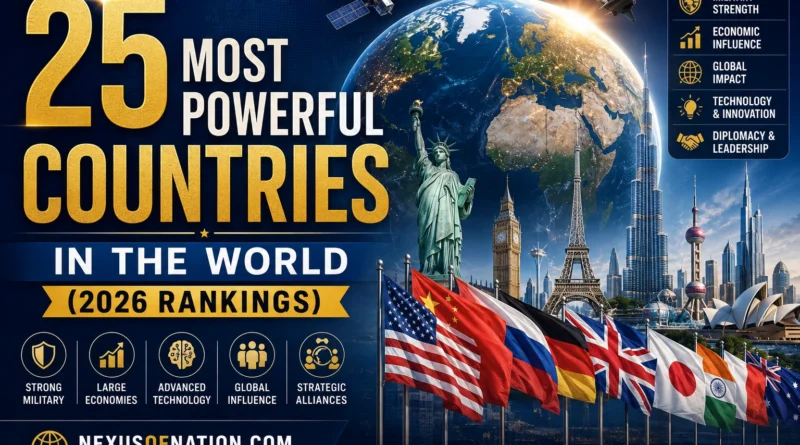
25 most powerful countries in the world. Measuring power is one of the most difficult aspects of geopolitics. it’s not simply GDP or military strength or size of population, but some mix of all three plus something that’s harder to measure: the rest of the world’s perception of a country’s power. The University of Penn State’s Wharton School, along with U.S. News & World Report and BAV, the brand analytics platform provided by WPP, addresses that question head on every year. They don’t rely just on hard economic and military data when selecting their nations’ rankings; their 2026 Best Countries Index polled more than 15,000 adults in 33 countries and has them rate the nations on power-related attributes. As per the survey, the following 25 countries are the most powerful ones in the world.
Key Takeaways
- The United States is one of the 25 most powerful countries in the world, with a relative power ranking of 100.0, which is the standard that all other countries are compared to.
- China is in second place at 93.6, while Russia is third at 91.4, although it has a much smaller economy than a few nations are lower down the chart.
- The top three are followed by the United Kingdom (84.3) and Germany (74.1).
- The UAE has become the largest riser in this year’s list, moving from 17th place in 2024 to 10th in 2026, which is due to investments in infrastructure, hosting of World Expo 2021-2022, and the creation of new free trade zones.
- After the top three, scores plummet, which indicates that very few countries are seen as genuine world powers, with the others having much more of a concentrated middle range.
- While Wharton’s methodology is different from that of other major indexes, such as CEOWORLD’s power index and Global Firepower’s military-only ranking, the top three is generally the same.
What this ranking actually means
Before you get to the list, it helps to know what this index is really measuring as it can be tempting to think of a power ranking as a simple sum of military spending or GDP. It isn’t. The Wharton Best Countries Index, on the other hand, directly has thousands of people surveyed and asks them to give countries a score on their power on various attributes: military strength, international alliances, political influence, economic influence, and leadership. That is, it is not based on hard capability data only, but also based on how the world sees the influence of a country. That is important, and accounts for some of the ranking’s quirky findings. For example, Russia is still considered to be a strong power, although its economy is smaller than that of countries that are thought to be weaker than Russia, but this is not just based on its economy, the size of its military and its geopolitical assertiveness.
The Top 10 Ranked
Based on the officially confirmed scores of the index 2026:
- United States — 100.0 (benchmark score)
- China — 93.6
- Russia — 91.4
- United Kingdom — 84.3
- Germany — 74.1
- South Korea (above France and Japan)
- Saudi Arabia (above France and Japan)
- France — 59.5
- Japan — 59.0
- The UAE, the biggest climber of the year, from 17th last year, topped the list.
Honourable mention goes to Canada, India and Turkey, countries that are often reported in the near-by analyses of the same data set as emerging or consistently powerful.
The UAE’s Jump Matters:
The UAE’s single biggest move from 17th to 10th in this year’s rankings is noteworthy. There was a deliberate strategy behind the climb, said David Reibstein, the Wharton marketing professor who heads the research, which involved concrete investment (airport upgrade, hosting World Expo 2021-2022, new free trade zones) and active work to influence global perception of the country. It’s a good example of the fact that countries can move up in the rankings, not only because of their economic growth, but because that growth can be communicated effectively to the rest of the world. As Reibstein explained, the real infrastructure of a country has to be improved, and the message must be communicated as well it takes two to move.
This is where the Middle Tier can get crowded.
One of the more interesting trends in this year’s figures is the dramatic drop after the first three. The spread is more pronounced than the 10th and 20th placed countries between themselves indicating that the world believes only a few countries are real powers, while a lot of countries are keeping pace to merge for the rest of the top 25. The middle segment, compressed, is where most of the year-on-year changes occur, countries such as the UAE have proven that significant progress is possible that isn’t necessarily confined to the highest rankings.
The other indexes are comparable in the following ways:
The Wharton index is not the only such measure of global power, and it is interesting to note in which direction other measures are in accord and in which direction they differ. The top three countries in the separate power index, derived from almost 300,000 responses gathered in late 2025, were the same three countries, albeit in a different order: the United States first (95.36), China second (94.86), Russia third (94.81) a far different line up than Wharton’s, which ranked India fourth, ahead of the UK and Japan. Global Firepower’s index, on the other hand, ignores public perceptions altogether and rates nations solely on the basis of military hardware and troops based on over 60 factors – a gentle nudge to remember that “power” can have several different definitions depending on what’s being measured.
The Bigger Picture
The world’s rankings, whether based on one methodology or another, tell the same tale: a clear top tier of countries (US, China, Russia) which remain stable and a second tier of established countries (the UK, Germany, France, Japan) which stay within a fixed range, with a well-defined middle tier of countries such as the UAE, South Korea, India and Turkey which are making progress. The basic picture for 2026 is the same, whether it’s by popular vote, military equipment or economic strength, the top remains pretty consistent from one year to the next, though the overall picture is one of a marginally more decentralized world.
A Note on Sourcing
Data for this article comes from the 2026 Wharton Best Countries Index as well as reporting and analysis from Visual Capitalist, Avio Space and Knowledge at Wharton. For comparison’s sake, comparative statistics from CEOWORLD magazine’s power index and Global Firepower’s military ranking are provided, but must not be interpreted as directly comparable to Wharton’s perception-based scores, as each provides different information and is measured by different methods. The full index can be accessed by the reader for the complete list of 85 countries.
