
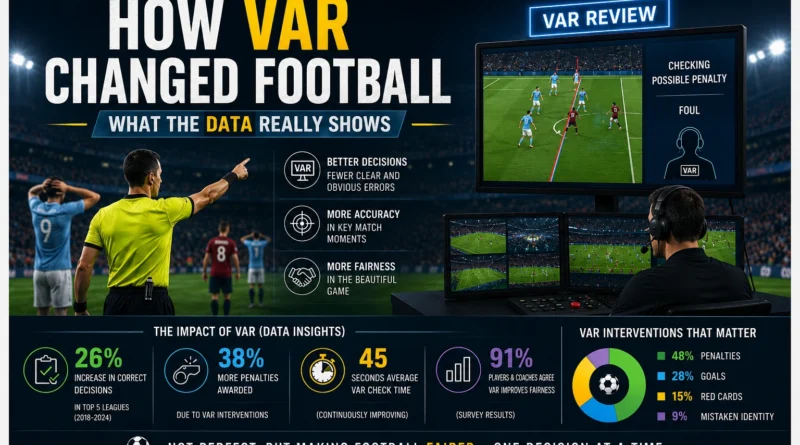
How VAR Changed Football – What the Data Really Shows
How VAR changed football, V.A.R is one of the innovations that has split football fans. VAR has been lauded since its inception for fixing egregious errors by the officials and has been faulted as much as it has been praised for doing the opposite; eliminating the spontaneity of the game. A decade into its existence in the leading leagues throughout Europe, the facts start to emerge and the anecdotes and arguments fade, leaving only a single question remaining: how did VAR transform football?
Key Takeaways
- The only match statistic that exhibited a strong, statistically significant difference that how VAR changed football, following VARs was the number of offsides, which decreased by approximately 0.5-1.2 per match.
- In a large meta analysis (20 competitions, more than 9000 matches) no statistically significant difference in total goals scored per match was seen after VAR was introduced.
- Studies always demonstrate a reduction in number of fouls and offsides and no significant change in number of red cards following VAR implementation.
- Match playing time has measurably increased with VAR (one meta analysis indicated significant differences in match length in the 1st half, 2nd half and total playing time).
- A VAR vs. a non-VAR-centric approach to the 2025/26 Premier League season caused a difference in the final season standings for several clubs, with some making more savings from the errors than others.
The Promise: Clear and Obvious Errors are Eliminated
For how VAR changed football, the introduction to elite football came with a very narrow brief: to catch any clear and obvious error by the referee, which was most commonly the awarding of a goal, the awarding of a penalty, a direct red card or an error of identity. It’s not intended to be a replacement for every minute-by-minute judgment made by a human referee at match speed, but a backup system of last resort for when a human one makes a mistake. The technology has been more or less successful, depending on that metric. The accuracy of the officiating in the specific categories VAR was designed to review has been enhanced in the leagues that have embraced it. The conflict has always been over how VAR changed football have gone beyond this very limited mandate.
The actual facts behind the data
VAR has certainly changed the way football is officiated, but its impact on the game is more complicated than many expected. In over 9,000 matches in 20 competitions, the absolute numbers of goals scored per match did not change significantly, indicating that the impact of VAR on the entertainment value has not been direct in this respect. It has made an impact on offsides calls in particular, which has always been reduced as VAR enables officials to make more accurate decisions, and attacking players to make more precise calls. VAR has also had an impact on fouls, yellow cards and penalties, though less distinct, and red cards numbers are staying pretty much the same. The one thing that’s most obvious, however, is longer games, because there’s a lot of extra time that’s added with video reviews and stoppages.
The Uneven impact Across Clubs
In addition to the league-wide numbers, VAR’s error correction (or their errors) has not been consistent. Some teams performed better than others from overturned calls, with those such as Wolverhampton Wanderers found to be in a net negative situation when VAR errors occurred throughout the season despite being close to the bottom of the table. Tottenham were seen to have had a net negative due to VAR errors, too, in what was a crucial season on the pitch, especially given how close the relegation fight was. This disparity is one of the most often voiced complaints from fans: Not only are there errors left in the VARs, but the ones that do remain are spread out evenly throughout the league.
So, did VAR “Change” Football?
Neither side of the debate accounts for the truth based on research—let’s get more nuanced. But VAR hasn’t changed the nature of match play in the primary sense, since there aren’t any great changes to any of the basic stats, such as goals scored, most of the technical measures, or anything related to how the game flows. What it has changed is more specific – fewer offside goals stand; fewer fouls are uncalled; more penalties are awarded; and matches are now considerably longer. But for fans, that specificity could be the reason why the debate hasn’t settled. VAR provides just the level of accuracy it promised for the marginal, close calls that fans care most about at the moment, while also removing an element of the game that can be seen in the numbers—time and spontaneity. But both can be right at the same time and, amazingly, after a decade, the arguments surrounding how VAR changed football do not seem to be disappearing.
A Note on Sourcing
The article is based on peer reviewed research published in peer reviewed journals, through outlets, and on systematic meta-analyses on thousands of matches played in several European football leagues, as well as on football analytics reporting. It is important to remember that the results are different in different studies and competitions, and that researchers have noted that the effects of VARs are different in various leagues and governing bodies, meaning that conclusions should not be drawn in all competitions where the technology is being used.
