
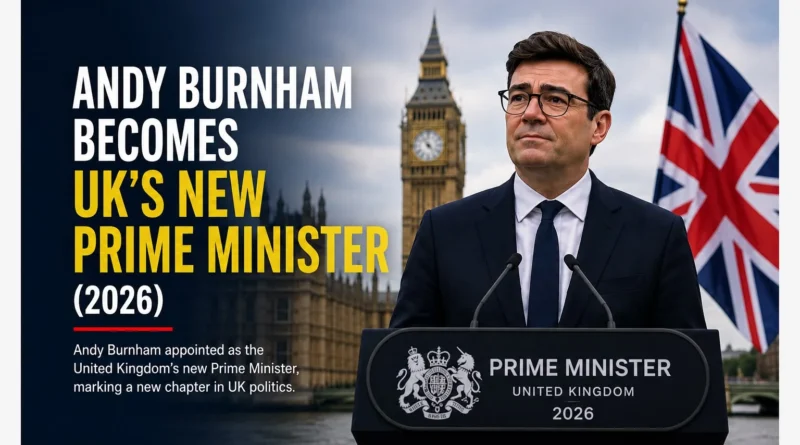
Andy Burnham Becomes UK’s New Prime Minister (2026)
Key Takeaways
- Andy, the ex-mayor of Greater Manchester, has officially become the Prime Minister of Britain on Monday, July 20, 2026. He is the UK’s seventh prime minister in a decade.
- Andy Burnham succeeds Keir Starmer, who resigned this month after a two-year long tenure plagued by plummeting approval ratings, electoral losses, and economic stagnation.
- Unlike in the United States, the premier of the United Kingdom can be replaced before the parliamentary elections if the ruling party loses momentum. This is precisely why Burnham was elected leader of the Labour Party, and he immediately became the Prime Minister of the United Kingdom.
- Burnham was elected leader of the opposition with an overwhelming majority, securing the support of 379 of the 401 Labour MPs, and has become the only candidate to secure the required number of nominations from his parliamentary colleagues. Andy Burnham has started to reshape the Labour Party’s cabinet, replacing some of Starmer’s ministers with his own people, including the new Treasury chief Rachel Reeves and the new Deputy Prime Minister David Lammy.
How Did “The King of the North” Get Here?
Andy Burnham is a former mayor of Greater Manchester. He kept the position for almost a decade and built a national profile as the maverick voice of the north of England, but “King of the North” had to resign to become an MP. He won the by-election in Maker-field in June 2026 and became an MP for the first time. Then, Burnham positioned himself as an alternative to Starmer and won the Labour Party leadership contest. The former mayor defeated numerous candidates, including Sir Kevan Jones, who tied with him for second, and became the new leader of the opposition. Altogether, Burnham secured the support of 379 of the 401 Labour MPs and became an unavoidable choice for his party.
The Prime Minister’s Inauguration
Since the Labour Party has a parliamentary majority, its leader, by default, becomes the Prime Minister of the United Kingdom. Thus, on Monday, July 20, Starmer gave a farewell speech to the city outside 10 Downing Street, saying that he led Labour “from a historic defeat in 2019 to a landslide general election victory in 2024.” Earlier on Monday, the ex-leader of the opposition formally resigned as head of the Labour Party and as Prime Minister. He laid out his speech in front of Buckingham Palace and announced his resignation to King Charles III. Meanwhile, newly elected Andy Burnham arrived at St. James’s Palace for the “kissing hands” ceremony.
Who Is Andy Burnham?
The new Prime Minister of the United Kingdom is a 56-year-old “slacker chic” who wears “dark t-shirts and jeans” in his constituency surgeries. However, Burnham put on a suit for the photographing session at Buckingham Palace. In addition to being the mayor of Greater Manchester, he was also a “straight talking” critic of the Establishment. In other words, Burnham was a “rogue Labour MP” who criticised his party’s MPs in the upper chamber of Parliament when they were in_office. He gained notoriety as a maverick and independent voice in contrast to the “dreary” Starmer. In his speeches, Burnham promises to deliver “a new politics” to make “Britain’s real change” and “end Britain’s cycle of economic stagnation and political unrest.”
What Does It Mean for the Coming Cabinet and Policies?
On Tuesday, July 21, Burnham got to work and began his Cabinet reshuffle, replacing some of Starmer’s ministers with his supporters. Some of the most notable names in the new cabinet included Treasury chief Rachel Reeves and Deputy Prime Minister David Lammy. The new Prime Minister spoke of his plans for Britain during his maiden speech as head of state. In his speech, Andy Burnham pledged to confront a cost of living crisis, decentralise power, rejuvenate industry, and end homelessness. The focus of the new Premier will be on breaking the “cycle of economic stagnation and political unrest.”
Why Did Starmer Lose?
Keir Starmer led Labour to a landslide general election victory in 2024. Starmer was able to lead the Labour Party to victory in the general elections in 2024 after a “historic defeat” in 2019. However, his tenure as Prime Minister and Labour leader lasted only two years. First, Starmer faced multiple defeats in key referendums and by-elections, weakening his credibility as a leader. Second, the UK economy continued to struggle, with voters criticising Starmer for failing to deliver on promises to reduce illegal immigration and control public spending. Finally, the Labour leader lost the confidence of the British people and decided to resign as leader of the opposition in June 2026.
What Challenges Does the New Leader Face?
The new Prime Minister faces many of the same challenges that his predecessor did when he took office. Namely, the economy is not in the best position, and the UK continues to deal with a cost of living crisis. Reform UK, a populist rival party led by Nigel Farage, is capitalising on the unrest and is gaining ground. In addition, Starmer had a “love-hate relationship” with the “unreliable” American ally across the pond. The new Premier has a lot to live up to given the gravity of circumstances, as noted by NPR. Notably, the Labour leader barely won the general elections two years ago but has struggled to retain voter confidence since then.
A Closing Statement
This is a breaking news story, so updates will continue to follow. Information contained in this article is accurate as of July 21, 2026, and is based on reports from the Associated Press, NPR, PBS News Hour, CBS News, NBC News, and The Washington Post . This post will be updated as more information about the new government emerges. To read more news about world leaders, visit the Nexus of Nation.
