
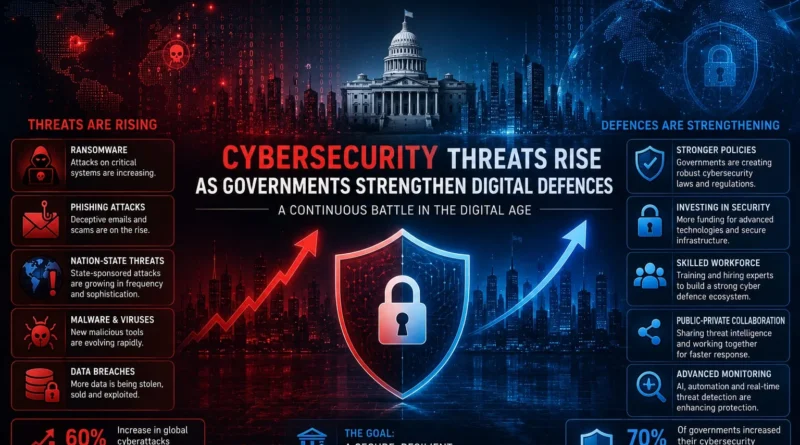
Cybersecurity Threats Rise as Governments Strengthen Digital Defences
Key Takeaways
- Cybersecurity threats State-sponsored espionage, ransomware, and supply chain attacks, are on the rise and pose a growing economic risk. The damage ranges from hundreds of millions to several billions of USD annually.
- AI enables attack surface expansion through more advanced and pervasive digital probing, while also fuelling better defences.
- Energy, healthcare, and government agencies are the most common targets as attackers seek to probe and exploit weaknesses in critical infrastructure.
- Governments are bolstering reporting requirements, cybersecurity budgets, and zero-trust security frameworks.
- While the investment is significant, organisations and governments are finding it challenging to respond to the increased attack surface and speed of probes.
The Growing Cybersecurity Threat Landscape
Cybersecurity threats have become omnipresent, with ransomware being the most damaging type of attack. Cyber criminals are using more sophisticated tactics to threaten organisations by stealing data and encrypting it, blackmailing companies into paying large sums of money, and publishing the data if theransom demands are refused. Most concerning is that the time between the identification of a weakness and its exploitation is significantly reduced, forcing organisations to invest in improved monitoring and identity-centric approaches to cybersecurity. The overall spending on information security is projected to skyrocket in 2026 as firms invest in countering ransomware groups and better protecting the cloud against AI-fuelled and sophisticated supply chain attacks.
Who are the Cybersecurity Threat Actors?
There are different types of threat actors, including:
- State-sponsored hackers – These are private entities hired by governments to target rival states’ critical infrastructure, such as the electric grid.
- Ransomware groups – Cybercriminals target organisations by encrypting their data and demanding the ransom payment in cryptocurrencies. Healthcare organisations have become the main target of ransomware attacks.
- Hackers with AI-fuelled attack software – This new type of attacker uses AI to launch highly sophisticated attacks, starting with automated and large-scale reconnaissance campaigns.
Government Cybersecurity Policy, Regulation, And Oversight
Governments are implementing stricter reporting requirements for organisations, especially those in the critical infrastructure sectors, such as the energy sector. For instance, there is now a legal requirement in the U.S. for infrastructure owners to report ransomware payments after years of voluntary disclosures. Additionally, the government is promoting zero-trust policies that require organisations to implement stricter security measures and ensure all data accessed digitally is protected. These policies have been mandated in many laws and regulations, including cybersecurity laws, rather than being recommended as best practices.
Government Cybersecurity Infrastructure, Capabilities, And Investments
The government is continuing to invest significantly in cybersecurity infrastructure, including the development of AI tools capable of detecting and countering ransomware and other forms of cyber threats. This includes developing better incident response tools for federal organisations and promoting cybersecurity workforce development. Besides working on in-house capabilities, the government is encouraging partnerships between the private and public sectors in sharing threat intelligence to better protect critical infrastructure. Additionally, federal cybersecurity officials are beginning to view budget investments as a way to promote national security as they continue to allocate more resources to countering ransomware, supply chain attacks, and AI-fueled cyber threats.
Cybersecurity Gaps, Weaknesses, Vulnerabilities, And Political Criticisms
Despite the increased cybersecurity investment, many experts are pointing out vulnerabilities and weaknesses that continue to challenge national security. Most notably, critical infrastructure and government agencies are failing to follow the basics of cybersecurity, leaving them exposed to nation-state ransomware attacks, especially with the growing use of cloud technologies. Experts note that most of the damage comes from the organisations failing to utilise available security technologies. Additionally, the threat landscape is expanding as malicious attackers are using new types of disinformation campaigns to target public officials and undermine policymaking, a challenge that traditional cybersecurity tools such as endpoint security solutions cannot address.
What This Means Going Forward
The situation surrounding cybersecurity illustrates a long-term trend that is likely to characterise the next decade or two, in which attackers will adopt AI to target more potent infrastructure and data, posing a significant risk to organisations’ ability to operate. Unless there is a global agreement on resolving particular cybersecurity challenges, such as addressing ransomware and supply chain attacks, the attack surface will only continue to grow. While many state-sponsored groups will continue to target other states, critical infrastructure, and government agencies, corporations will also be prime targets as attackers threaten to publish data unless they pay substantial ransoms.
A Final Word On Information Sources
Due to the situation’s complexity and frequent changes, many facts and situations in this piece, as well as throughout Nexus of Nation, may be subject to debate and change significantly over time. The figures cited in this article regarding cybersecurity spending come from government and organisation reports, while the information on ransomware, attack trends, and the response comes from cybersecurity analysts and researchers. Readers should evaluate the information on who is attacking with caution because organisations often accuse each other of launching ransomware and other cyber-espionage attacks when tensions are high.
