
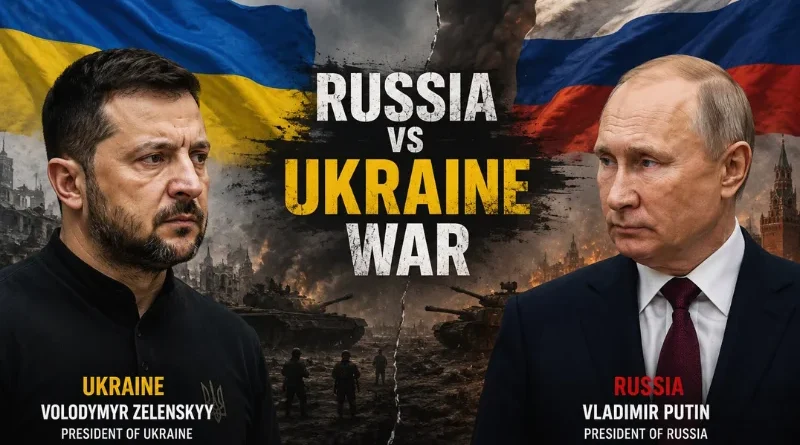
Russia-Ukraine War: Latest Developments (July 2026 Update)
Key Takeaways
- In Russia-Ukraine War, Russian forces have gained a small but significant amount of territory in Ukraine in the last month, with the fighting intensifying in the Sloviansk and Pokrovsk regions.
- Meanwhile, Ukraine’s air defences are stretched to the limit after failing to shoot down a Russian ballistic missile barrage that struck the capital on July 6, and intercepting fewer of Russia’s Patriot-targeted missile salvoes, due to limited munitions.
- Ukraine has also launched a major offensive against Russia’s “shadow fleet” of tankers and support ships in the Black Sea and Sea of Azov, sinking several tankers in mid-July.
- Inside Ukraine, meanwhile, there were reports of tension between the government and the country’s dismissed defence minister, with the latter criticising the leadership of Ukraine’s armed forces.
- Furthermore, a twenty-point peace plan is said to be on the table, with the details of the dispute, including territorial issues, still being ironed out.
Battlefield Developments
The Russia Ukraine War’s territorial gains are proceeding slowly but steadily in favour of Russia. According to DeepState, as of July 7, 2026, Russia has gained approximately 31 square miles of territory since June 9, 2026 – compared to virtually nothing the month before. Meanwhile, according to the Institute for the Study of War (ISW), the number is close to 6 square miles, indicating the discrepancy of the data on this issue. The confrontations are ongoing, with the largest concentrations of fighting occurring around Sloviansk and Pokrovsk. Ukraine is relying more on its asymmetric and maritime capabilities, including the Unmanned Systems Forces, to target the “shadow fleet.”
Missile and Drone Strikes on Ukraine
Attacks on Ukraine’s urban centers are the norm, with a large-scale Russian drone and missile strike hitting the capital of Ukraine on the night of July 1 – 2, 2026, killing at least 27 people and wounding 91 others. It was reported that Russia’s upgraded strike capabilities are making it more difficult for Ukraine to defend its cities, resulting in increased civilian casualties, despite a dip in the number of large-scale attacks in recent weeks. Ukraine’s air defence capabilities have also been severely tested, with claims of intercepting only 14 out of 54 ballistic missiles in Russian missile strikes in June 2026.
Political Developments Inside Ukraine
Politics in Ukraine have been fraught with tension in recent days, with reports of discord among senior military commanders. This issue arose after the dismissed defence minister criticised the Chief of the General Staff of Ukraine, Oleksandr Syrskyi, for his performance as commander-in-chief of Ukraine’s armed forces. Specifically, Mykhailo Fedorov claimed that Syrskyi committed a “disastrous mistake” by not achieving success in Ukraine’s drone warfare. According to reports, Fedorov had even requested President Volodymyr Zelenskyy to dismiss Syrskyi; however, Zelenskyy refused to do so. The situation reflects the challenges of the war in Ukraine, where tensions are increasing inside the country, with criticism of both the government and the military leadership.
Diplomacy and Peace Talks
The diplomatic track is the most promising for ending the full-scale Russia-Ukraine War, and the Trump administration is reportedly making considerable efforts to facilitate negotiations. In particular, reference was made to a twenty-point peace program, a draft of which was developed jointly with Ukraine. Ukraine has reportedly accepted the general principles of the program; however, it did not fully meet Russia’s demands, particularly concerning territorial issues. Despite attempts to promote the peace initiative, it remains unclear what specific steps will be taken to bring about a cessation of the fighting, with previous diplomacy efforts stalled on this issue.
The Big Picture
It has been more than four years since the full-scale Russia-Ukraine War began, and Russia continues to occupy approximately twenty percent of Ukraine’s territory. Despite Russia’s territorial gains, the front is still characterised by a prolonged and gruelling battle, with few large-scale offensives. Unfortunately, the human toll of the war has been extraordinarily high. According to Ukrainian sources, tens of thousands of residents and soldiers have died and hundreds of thousands of people are still missing. However, the situation in the last four years has changed significantly, with fewer overt offensives and the front being more balanced, albeit with both sides continuing to suffer heavy losses.
Note on Reporting Battlefield Gains in the Russia-Ukraine Conflict
Reporting on the Russia Ukraine conflict has become extremely politicised, with both sides presenting widely varying figures on battlefield gains, losses, and victories. The figures presented in the current article are based on third-party information, including ISW and Ukraine’s DeepState Open-Source Intelligence platform. Moreover, information on casualties, as well as destruction and damage, was reported by Ukraine. For more information on this topic, be sure to visit nexusofnation.