
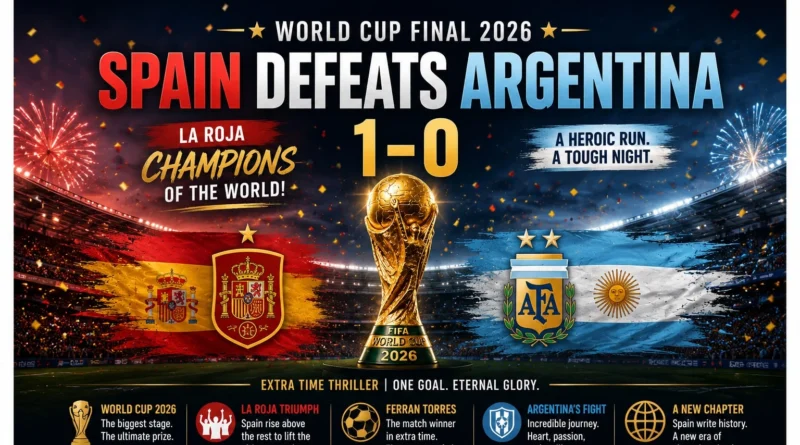
World Cup Final 2026: Spain Defeats Argentina 1–0
Key Takeaways
- In the World Cup Final, with the clock running out at the end of regulation, Spain scored their second World Cup in 16 years, beating Argentina 1-0 on the final whistle of extra time at MetLife Stadium.
- The winner came in 39 seconds after the end of the first period of ET, when Ferran Torres finished a close-range shot from a Lamine Yamal assist.
- In the final moments of world cup final Argentina sat 10-men down with Enzo Fernandez sent off for a second bookable offence in stoppage time.
- But it was a near certain that it would be Messi’s last World Cup performance and that the 39-year-old would only knock in a single shot in 120 minutes while Argentina had no shot in the entire first 90 minutes.
- It is the first time in World Cup final history that Spain will share the championship with the men’s and women’s teams.
- The presentation of the trophies was marred by boos that were yelled at Donald Trump and FIFA president Gianni Infantino and also rumblings of a post-match altercation involving Argentina’s Leandro Paredes.
A Final Decided by Control, Not Chaos
The goal-fest that was England’s third-place playoff two days ago was a stark contrast to the goal-less final that was – for much longer than it should have been – tense, very close and for a long time genuinely short on clear chances. From the first whistle, Spain had the majority of possession but the Argentine defense, led by a heroic Emiliano Martínez also called Dibu in goal, withstood them and were hardly a threat at the other end for more than 90 minutes. At the break, all the facts were staring them in the face: Argentina played 35% of the match and had neither a shot nor a corner nor a touch within the penalty area. Spain, on the other hand, was prepared to persist in its gentle testing without relinquishing its aim. By contrast, Spain refused to ‘take its time’ as did earlier opponents such as Egypt and England, who had tried to contain them.
The Goal That Finally Came
It was Spain’s moment of breakthrough that came early in extra time. The Spaniard’s 19-year-old wonder, Lamine Yamal, was allowed to break the two-man defence down the flank, hold the ball at the base of the byline then square it to substitute Ferran Torres, who hammered home from close range just 39 seconds into the second period of extra time. It caused a frenzy on the Spanish bench with substitutions coming out in a rush. Soon after, they doubled their lead with the introduction of the ball by Nico Williams but the goal was disallowed for a build-up penalty. It didn’t matter — Argentina, who had been forced to a 10-man side by their second yellow card in stoppage time from Enzo Fernández in world cup final, were unable to reply. They found the best way back into the game by a stray Giuliano Simeone effort that sailed over the bar and through a nervy goalmouth scramble that Spain just got by.
The end of an era for Messi
It was impossible to tell the human side of the match from the score line. Lionel Messi, 38 and almost certainly his last time at the World Cup final, managed only one shot in 120 minutes, which he hit in the face of Mikel Merino. The Argentinean talisman who had been tied for the Golden Boot with eight goals in the tournament was unable to make a difference as Spain’s defence closed Argentina’s attacking channels one by one. It was a quiet conclusion to a World Cup career that saw Argentina win a title in Qatar in 2022, and meant Argentina missed out on being the first team since Brazil in 1962 to successfully defend the World Cup final.
Spain’s Historic Double
The last nation to hold both World Cups is Spain, who now have both the men’s and women’s World Cup. It also ensures a golden generation under Luis de la Fuente, who has just secured Euro 2024 and a World Cup in just two years. Spain played seven matches in the tournament, conceding only one goal, a feat even better than the winning side in the last World Cup in 2010.
A stress-relieving Trophy Ceremony
The celebrations weren’t without controversy. It was reported that sections of the crowd booed Trump and president of FIFA Gianni Infantino who handed over the trophy together at the ceremony. Post-final, too, was a touch chaotic after the whistle, as Argentina forward Leandro Paredes was sent off for his role in a clash of personalities after the final bell.
By the Numbers
- In the first half, Argentina suffered a 20-2 defeat to Spain, who dominated them in both possession and attacking build-up. The first half was dominated by Spain, who had a 20-2 lead in terms of territorial possession and attacking build-up over Argentina.
- 1.94 xG to 0.2 xG, the expected-goals difference that reflected the disparity in chances, which were clearly one-sided despite the close score
- 7 occasions in the entire tournament that Spain conceded a goal, their total defensive record was 1 goal conceded. Spain conceded 1 goal in 7 games across the tournament.
- Two assists, Messi’s record for the tournament, behind only Kylian Mbappé’s three, in the Golden Boot race for assists
The impact of this on the future.
The victory is a testament to years of work done around technical control in Spain, and a sign that this generation, led by Yamal, Pedri and Rodri, has the ability to challenge the sport for years to come. The tournament caps a golden period for Argentina, which has produced a World Cup, two Copa Americas and one of the greatest careers in the history of the sport, albeit just shy of the “immortality” most people would have thought Messi would be able to achieve in his last World Cup campaign. Next World Cup four years away but for now Spain reign supreme at the top of world football.
A Note on Sourcing
The details, stats and quotes above are from the live match coverage and post-match reports. As with any live event, some minor details – especially regarding the post-match altercation – were still being sought from sources at the time of this writing and may change as additional reporting is released. Go and see Nexusofnation.
